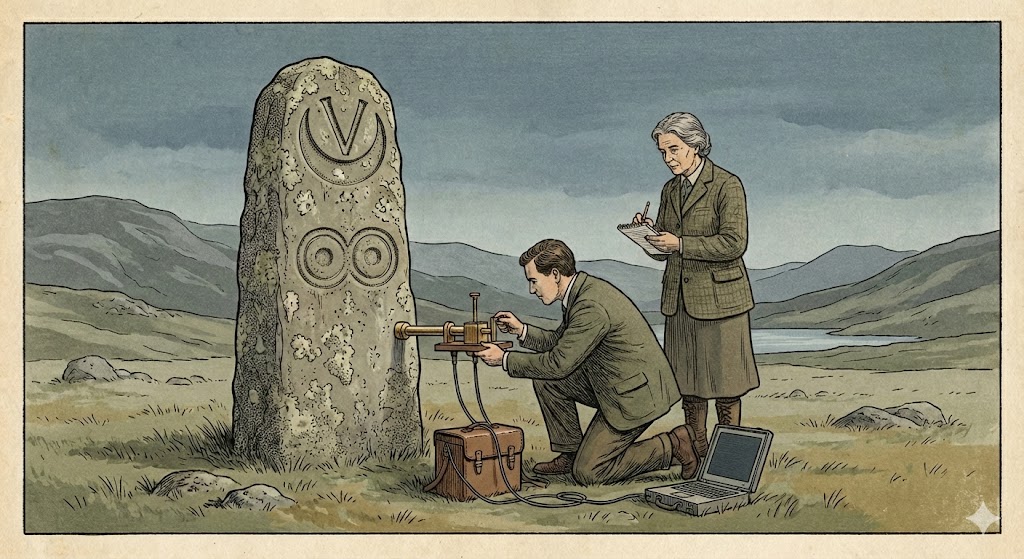
The standing stone had been waiting for fifteen hundred years.
David Mitchell crouched in the wet grass, adjusting the phase-difference array while rain misted down from a sky the color of old pewter. The stone rose behind him—Class I, undressed, bearing a crescent-and-V-rod carved sometime before the year 600. Margaret had photographed it a dozen times over the decades. Neither of them had understood what it was actually for.
"Array Beta is aligned," David said. "Separation distance 4.7 meters, same as the lab configuration."
Margaret stood by the stone, her tablet displaying the readout. The portable equipment was a fraction of what they had at Ames—two detector units in weatherproof cases, a ruggedized laptop running ARCHIE's analysis software. But the principle was the same: separated sensors, quantum state transfer, directional information encoded in the phase relationship.
"The V-rod points seventeen degrees west of north," she said. "Measured from the vertical bisector of the crescent."
"Running measurement now." David watched the readout stabilize. "Vector reading: eighteen degrees west of north. Uncertainty plus or minus two degrees."
Margaret was quiet for a moment. The particular stillness of a scientist encountering confirmation.
"That's within the error margin."
"One data point. We need more."
"The next stone is four hundred meters east. Different V-rod orientation."
"Then we walk."
They measured seven stones t…