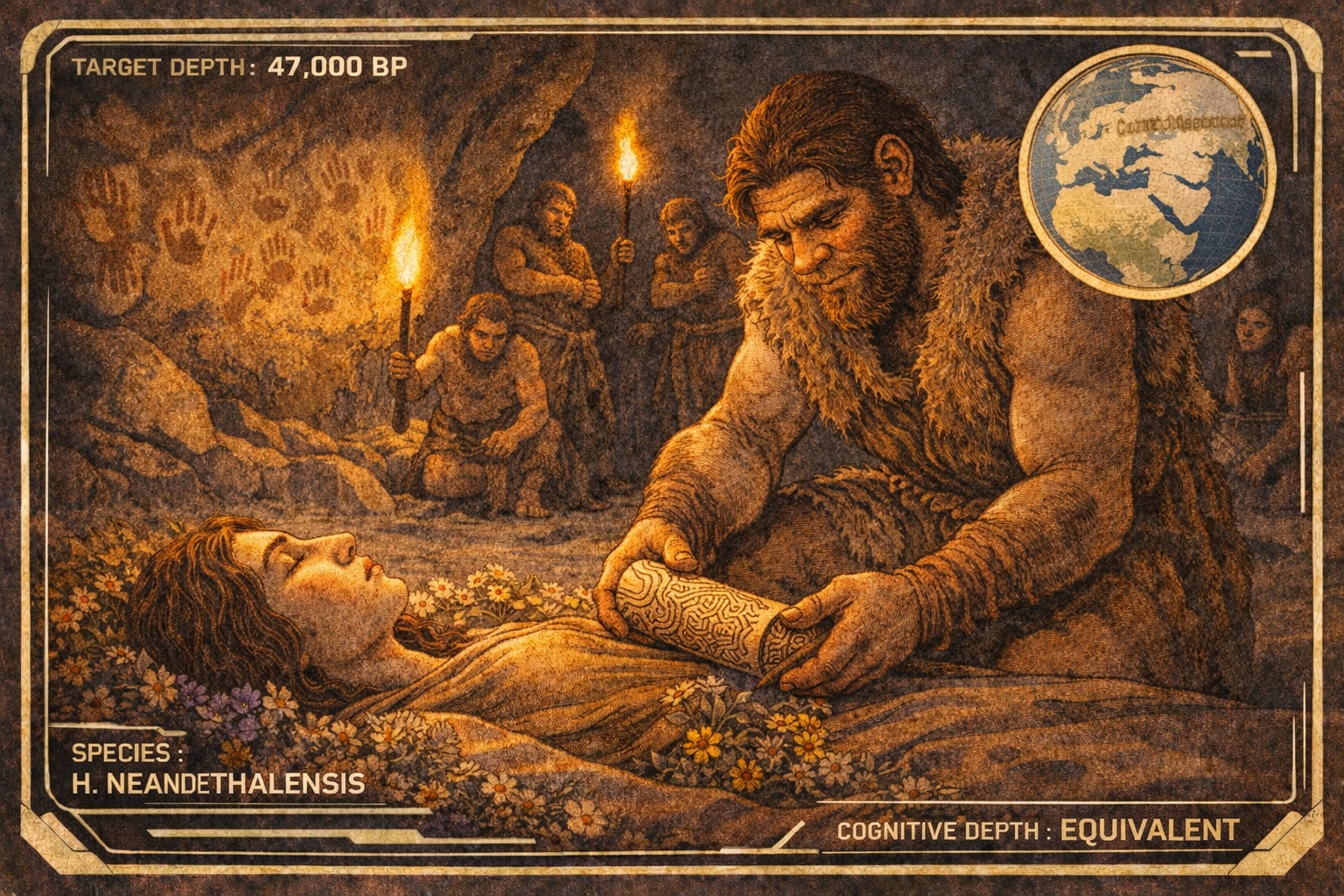
They were not what Susan had expected.
The textbooks described Neanderthals as stocky, cold-adapted, with prominent brow ridges—the visual shorthand for "primitive human." The individuals she was watching bore little resemblance to those reconstructions. They moved with grace. They spoke with complexity. They laughed.
"Target depth: 47,000 years before present," ARCHIE reported. "Western European cave complex."
The cave mouth opened onto a river valley thick with spruce and birch, the landscape locked in glacial cold. Snow lay in patches on northern slopes. The Neanderthals had built fires at the entrance, creating a warm zone extending deep into the rock.
"There are children," Margaret said quietly. "Playing."
Three young Neanderthals were engaged in a game—something involving sticks and a target painted on the cave wall. They shouted encouragement, groaned at misses, celebrated hits with gestures that transcended species. Children playing. The most universal behavior in the animal kingdom, here it was, fifty thousand years ago.
"They're fully conscious," Susan said. After yesterday's navigation—the early Homo sapiens with their ochre and reflections—she knew what consciousness looked like in the archive's rendering. These Neanderthals had it. The same recursive self-awareness.
An adult male sat near the largest fire, working on something. As Susan approached, the object came into focus.
He was carving.
The piece was mam…