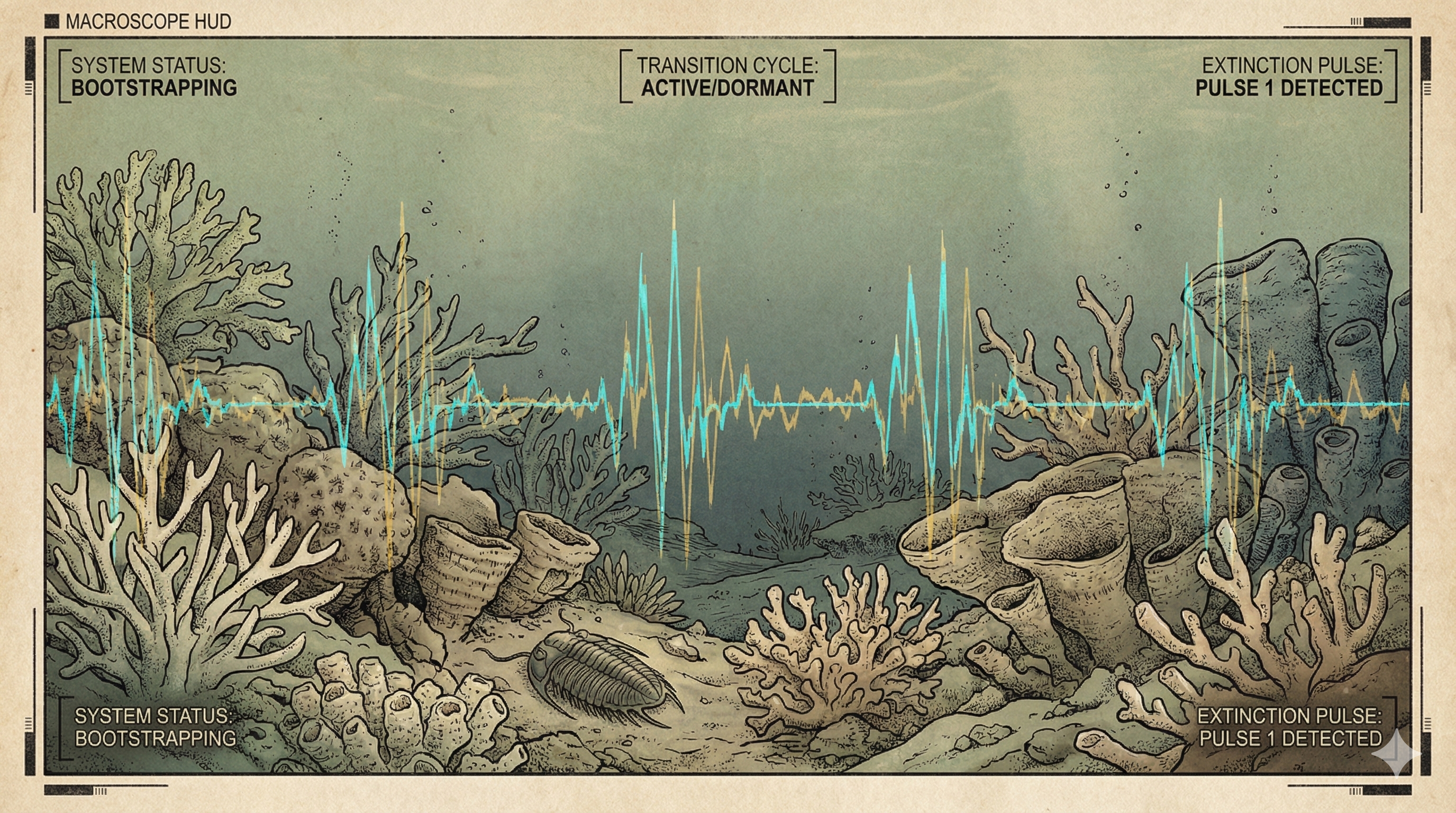
The reef was dying in stages.
Susan stood at the edge of what had once been the most diverse marine ecosystem Earth had ever produced—the great Devonian reef complex, stretching across shallow tropical seas that would become modern Australia. But the reef she saw was already damaged. Coral analogs bleached and crumbling. Stromatoporoid sponges reduced to rubble. The intricate architecture of 30 million years' construction coming apart piece by piece.
"First pulse temporal coordinate," ARCHIE reported. "374 million years before present. The Kellwasser Event has begun. Reef mortality at this location: approximately 40%."
"Forty percent and climbing," David said from the XR Lab. "The readings are unstable. Fluctuations I can't interpret."
"The stuttering," ARCHIE confirmed. "Activity cycles—up, down, up, down. The period is irregular. The amplitude varies. But the pattern is consistent across the temporal window."
Susan waded into the dying reef, her platform adjusting to navigate around collapsed structures. The water was warm but wrong—a subtle chemistry change that spoke of oxygen depletion, of organic matter decomposition, of an ecosystem choking on its own death.
"Show me the cycle. Visualize it."
The display appeared in her field of vision: activity as a waveform, pulsing up and down across the Late Devonian timeline. Not the steady hum of the Permian's competing signatures, not the flat silence of the Ordovician dormancy. Something in b…