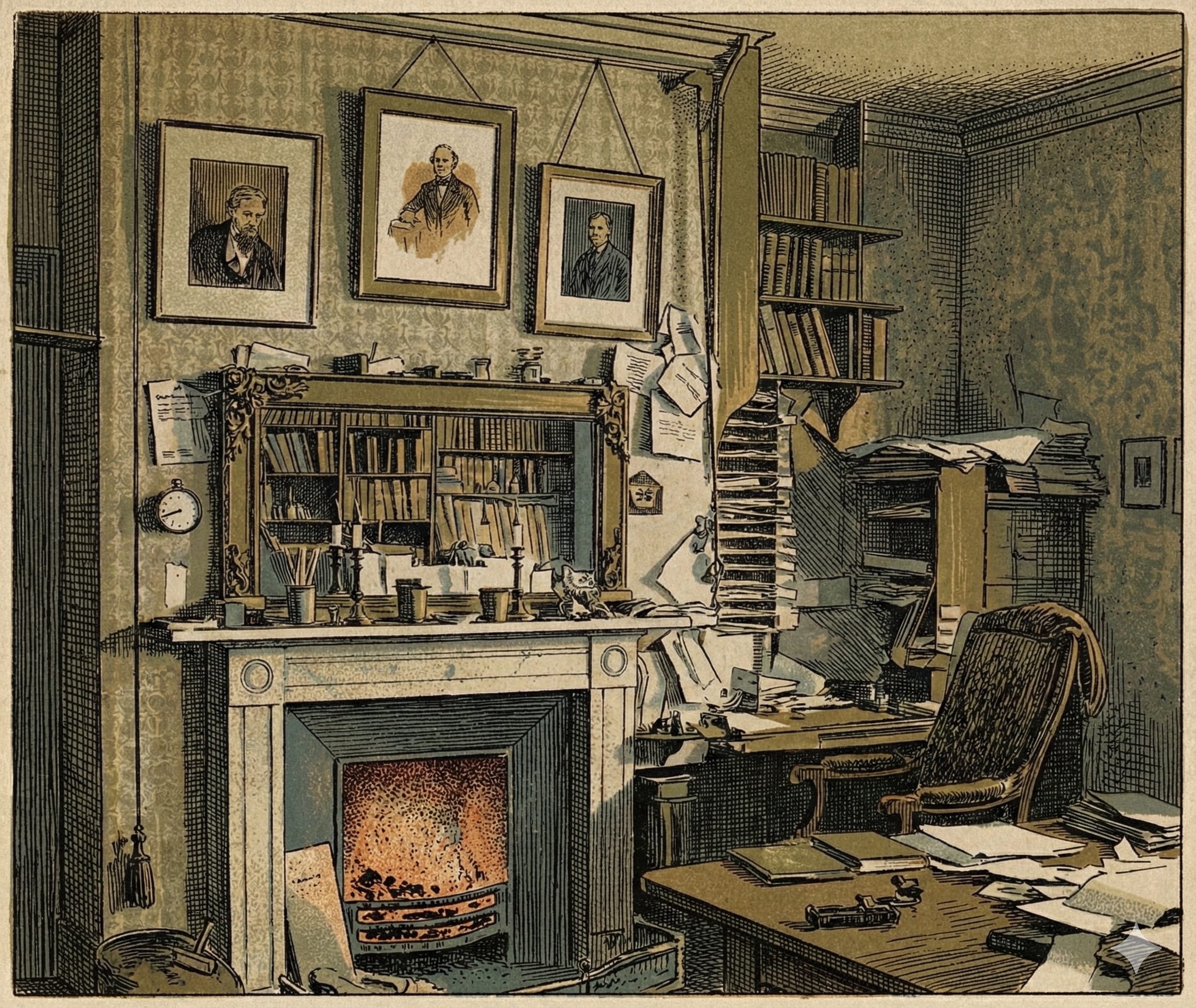
Down House, Kent, February 1871
The fire had burned low, and Darwin did not call for it to be built up again.
He sat in the leather chair that had molded itself to his frame over decades, surrounded by the accumulation of a lifetime's inquiry. Papers covered every surface—correspondence awaiting reply, proofs requiring correction, notes toward arguments he might never complete. The portraits of Lyell and Hooker watched from above the mantelpiece.
His pen had stopped.
The letter to Hooker lay before him, half-finished, the ink drying on words that felt inadequate to what he was trying to say. He had been writing about the origin of life—not the branching of species, which he had labored over for decades, but the deeper question. How had it begun at all?
Through the window, the February garden lay dormant under grey English sky. So different from that other landscape, that other time—the black rocks of Tierra del Fuego, steam rising into air cold enough to ache. Nearly forty years ago. He had been young then, still capable of believing that observation and reason would eventually illuminate all mysteries.
The springs had taught him otherwise.
He had never written properly about what he felt there. His notebooks contained measurements—temperature gradients, mineral deposits, the orange staining where hot water met cold stone. But the sensation itself he had reduced to a single line: *Unusual sensation in thermal water. Subjective….