The engineers arrived on Monday.
Priya had assembled them from Google's advanced manufacturing division—twelve specialists in microfabrication, bioprocess engineering, and robotic systems integration. Rob contributed four more from NASA's life sciences facility. They signed NDAs that would have made a defense contractor nervous, received briefings that explained just enough to make their work possible, and asked remarkably few questions.
"They're professionals," Priya said, watching the team unload equipment. Construction crews had already knocked out the west wall, extending the facility into adjacent space that Google had quietly acquired. "They don't need to know why. They need to know what."
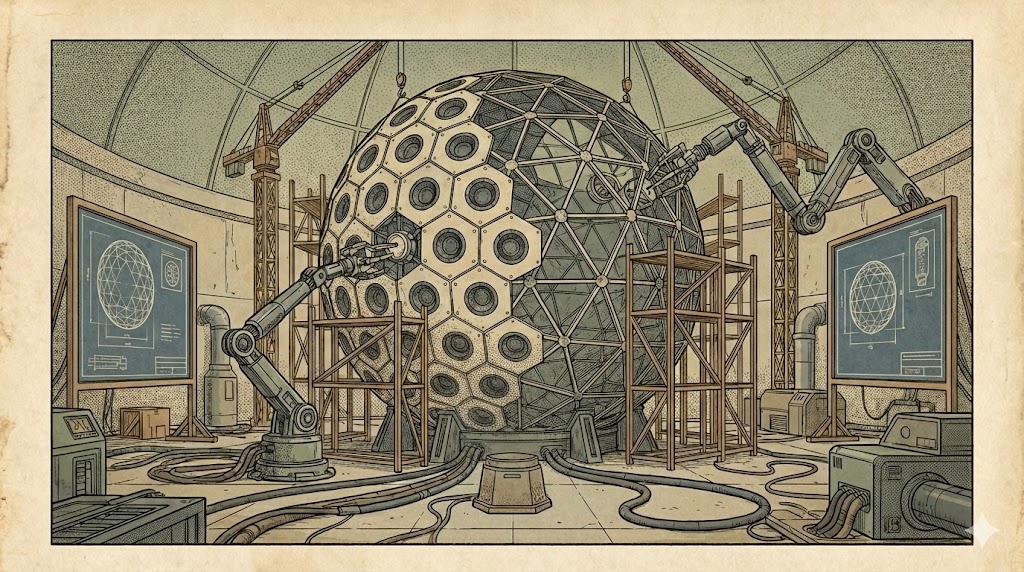
The expansion had transformed the BEEGL beyond recognition. The original navigation chamber remained at the heart—the XR stations, the field generator, the Rhynie artifact's former containment—but now it served as the nucleus of something far larger. Clean rooms radiated outward like spokes. Fabrication bays. Bioprocess suites. Integration chambers.
Amara stood at the center, neural link active, ARCHIE rendering the bioreactor schematics in her visual field. Sixteen engineers waited for direction. Six weeks to build something that had never existed.
"Three parallel workstreams," she announced. "Microfabrication team: field array components. Bioprocess team: nutrient systems and cellular interface. Integration team: robotic assembly and monitoring. Each st…