Interlude
Punta Alta — Darwin Timestream
821 words · 5 min read
PUNTA ALTA, SEPTEMBER 1833
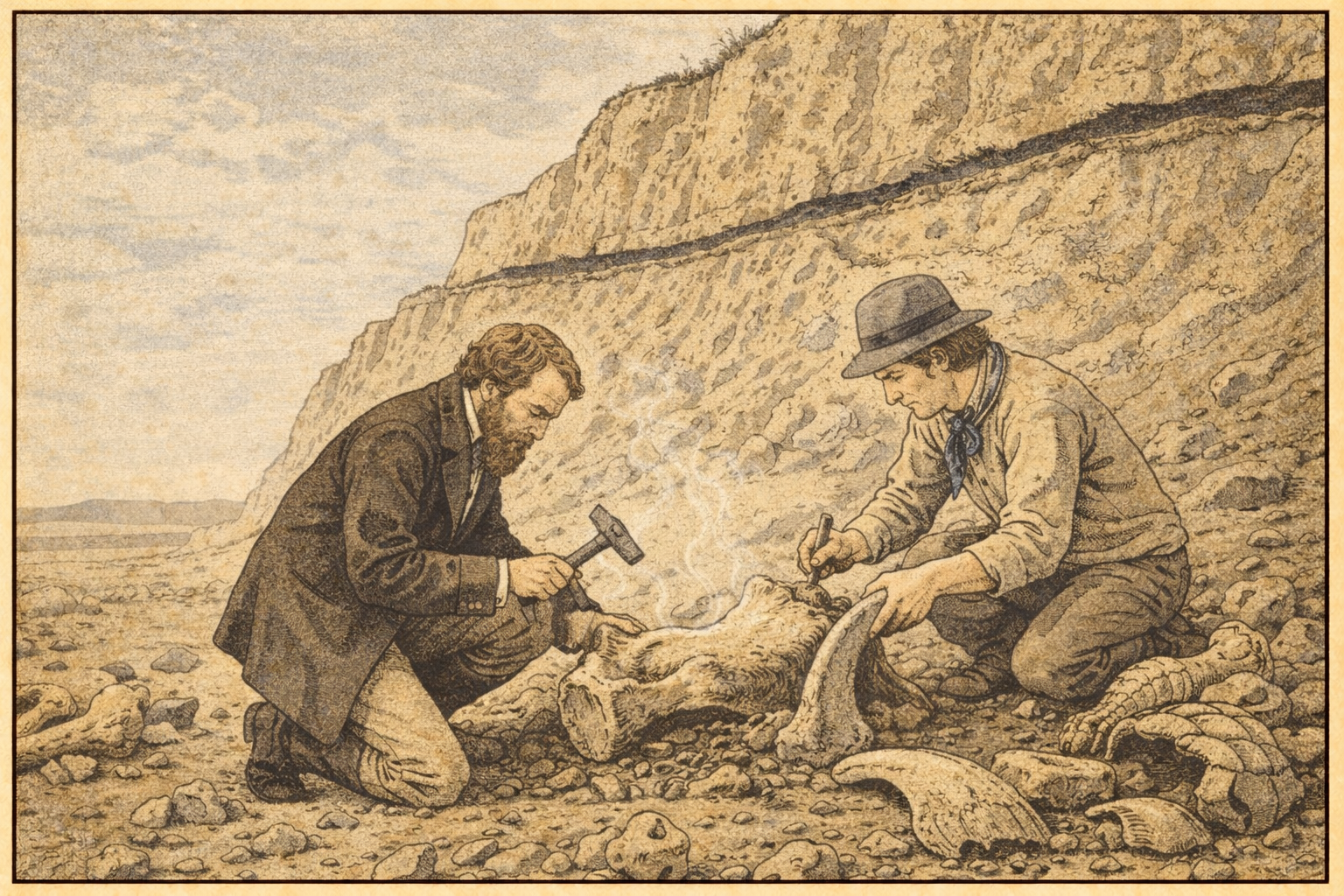
The cliff face crumbled under his hammer, releasing bones that had waited millennia for this particular Englishman to free them.
Charles Darwin did not know how many millennia. No one did, not yet. Deep time was a new country, and he was mapping it with a surveyor's chain and a relentless, hungry eye. He was twenty-four years old, and every specimen he packed was a silent rebuttal to his father's judgment: You will be a disgrace to yourself and all your family.
"Another vertebra here, sir," Covington said, brushing sediment from a massive curved bone.
Charles felt the familiar surge—that electric mixture of curiosity and ambition he could never fully separate. He wanted to understand these giants, but he also wanted to be the one who understood. He was not proud of this hunger, so he called it science and tried to believe that was all it was.
The giant ground sloth—Megatherium, he would learn to call it—was emerging from the sediment like a ghost demanding flesh. Beside it lay the armored carapace of a creature like an armadillo scaled to the size of a carriage.
He worked through the afternoon, Covington helping him extract what the cliff would yield. The sun pressed down. Dust coated his lips, his throat, the pages of his notebook. His hands ached. He did not stop.
There was something here. Not just bones—though the bones were extraordinary. A puzzle taking shape at the edge of his perception.
These creatures were South American. Not in the trivial sense of being found here, but in their architecture. The giant sloth shared structural kinship with the small sloths still hanging in the forests to the north. The massive Glyptodon echoed the armadillos he had watched rolling into defensive balls on the pampas. As if the living were diminished descendants. As if something connected the dead and the living across whatever vast interval separated them.
Why should that be?
He wrote in his notebook: This wonderful relationship in the same continent between the dead and the living will, I do not doubt, hereafter throw more light on the appearance of organic beings on our earth, and their disappearance from it, than any other class of facts.
He did not yet have the theory. That would come later—decades later, a lifetime of accumulation before he dared publish what the bones were telling him. But standing at the cliff face with dust in his teeth and megatherium vertebrae in his hands, he felt the shape of it. A relationship that demanded explanation.
As the light changed toward evening, Darwin moved to a different section of the cliff. The bone-bearing stratum had given way to something else—a thin dark layer, almost like ash, cutting horizontally through the pale sediment.
It was a bruise in the earth. He chipped at it, not expecting significance. The material was dense in places, with an unusual structure that resisted the hammer.
He pocketed a few fragments. Geological curiosity. The bones were the prize; this was merely context.
He could not know that the dark layer marked the boundary between worlds. That sixty-six million years before he stood squinting in the Argentine sun, something had fallen from the sky and ended an age. That the fragments in his pocket carried a residue of that ending—material that had traveled between stars before it traveled into his collection.
The bones above the layer and the silence below it told a story of severance. The resemblance he had noticed—the wonderful relationship between dead and living—was not merely descent but something stranger. A world already seeded with something older than any lineage.
"The crate is full, sir," Covington said.
Darwin stood, fingers tracing the dark fragments in his pocket. The cliff face held his attention in a way that exceeded its scientific interest. He had felt this before, in other landscapes. A sense of significance that outran his capacity to explain it.
Why then, he would write years later, have these arid wastes taken so firm a hold on my memory?
He had no answer. The question itself was the finding.
The sun set over Punta Alta. Darwin packed his specimens and walked back toward the ship, carrying fragments of two extinctions—one he was beginning to understand, one he could not have imagined. Tonight he would write up the day's work by lamplight, make the bones into language, the language into letters, the letters into a reputation that might finally purchase his father's silence.
But the dark layer stayed with him.
The earth remembers. It was what the earth did.
Darwin climbed into the ship's boat, his pockets full of evidence he could not read, and was rowed back to the Beagle through water that held no answers, under stars that offered none.
But he was asking. That was the beginning.