Chapter
WILBUR HOT SPRINGS — EVENING / DAWN
1,322 words · 7 min read
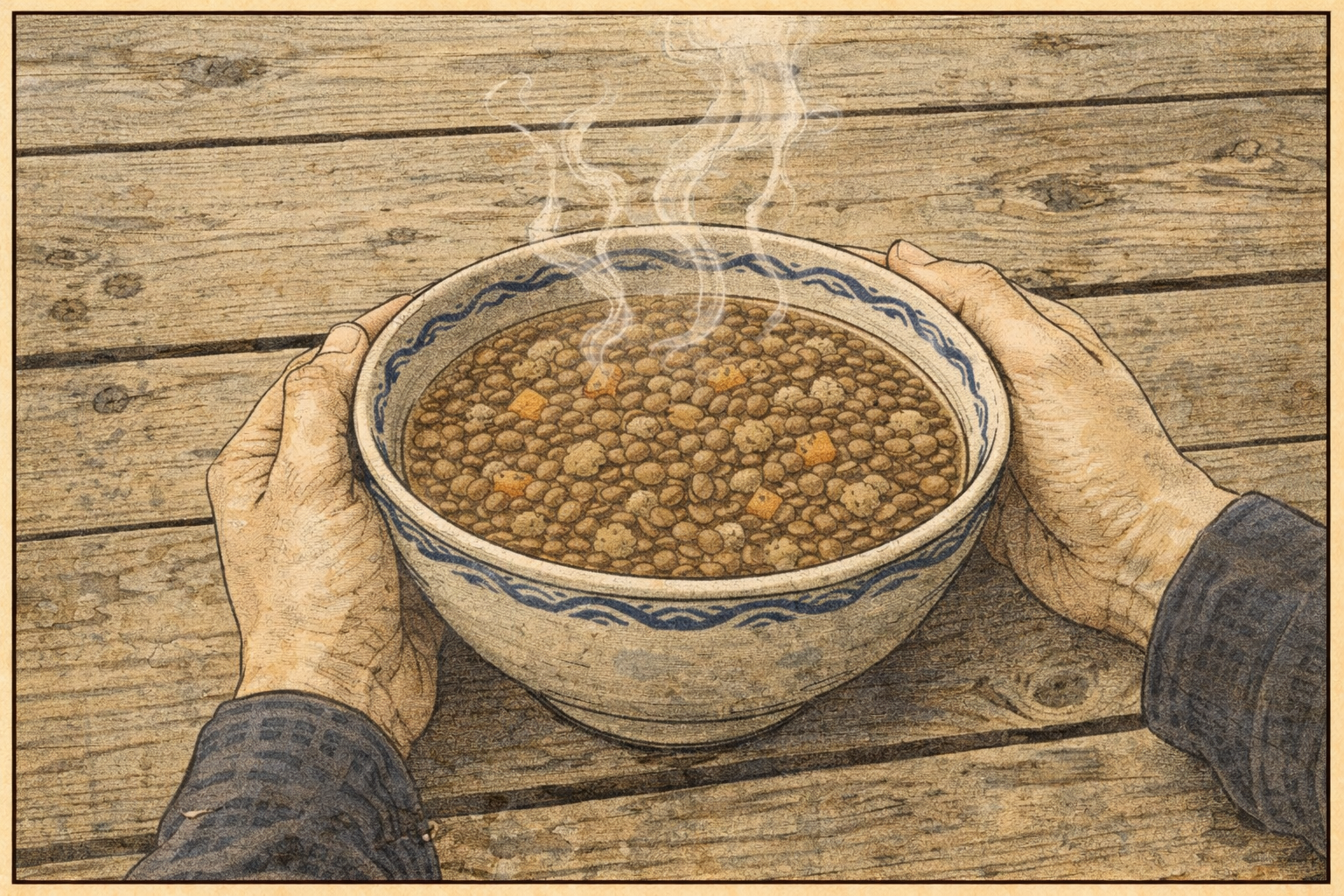
The lentils were decent, but the data was better.
Susan sat at the long communal table, iPad propped against a water glass, her bowl pushed aside. Through the window, the sun was draining from the hills, turning the dry grass the color of old bronze.
She should be in the flumes. Forty years of fieldwork had turned her knees and lower back into a map of aches that only Wilbur's mineral water could navigate. She didn't need a spiritual framework to appreciate what lithium and boron did for her joints.
But the drone footage wouldn't let her go.
She had built a career on serpentine ecology—the toxic soils, the stressed plants, the slow dance of adaptation. She understood this landscape. She had walked these plots a thousand times.
From the air, the buckwheat populations didn't look like random distribution.
The variation mapped onto the hillside in nested arcs. Not gradients of soil chemistry, but precise curves. They repeated at different scales, a recursive architecture that shouldn't exist in a high-stress, patchy environment. She'd flown the same transects three times, thinking it was an artifact of the imaging, the afternoon light, something wrong with the stitching software. It wasn't.
She thought of her father—the physician who'd taught her that diagnosis meant looking until you saw what was actually there. The patient will tell you what's wrong, if you know how to listen. The plants were telling her something. She just couldn't hear it yet.
"You're staring at that thing like it owes you money."
Susan looked up. Jennifer stood at the end of the table, bowl in hand, her sun-bleached hair loose around her shoulders. She looked the way she always looked at Wilbur: relaxed, alert, slightly amused.
"Sit," Susan said. "How was the morning session?"
"Brutal. The good kind." Jennifer settled across from her. "Aerial surveys?"
"Bear Valley. The buckwheat." Susan turned the screen. "I've worked this soil for twenty-five years. I thought the variation was driven by patchy magnesium levels. But look at the orientation."
Jennifer traced a thirty-meter spiral with a fingertip. "A spiral? Seriously?"
"Not just spirals—organized spirals. Nested. Repeating at different scales." Susan shook her head. "Serpentine soils should produce noise, not this."
Jennifer went quiet. When she looked up, something had shifted in her expression.
"How long have you been seeing this?"
"Two years. Since I started the drone transects."
Jennifer set down her spoon. "I need to tell you something. And I need you to stay with me before you dismiss it as Wilbur-woo."
Susan almost smiled. This was their long-standing negotiation. "Go ahead."
"There's a man here. David Coyote. People call him Starseed." Jennifer held up a hand. "I know. But I've been watching him for years. He has visions in the water, at dawn. He draws them afterward—crescents, zigzag lines, beasts with spiral joints. He thinks they're transmissions from ascended masters. But Susan, the shapes he describes sound exactly like what I'm looking at on your screen."
Susan felt a chill that had nothing to do with the evening air.
"He draws them?" she asked.
"Identical every time. Structured. He thinks it's sacred geometry. I think you need to meet him."
"When?"
"Tomorrow at dawn. The flumes. That's when he says the reception is clearest." Jennifer's mouth quirked. "His word, not mine."
The Fluminarium was a cathedral of steam.
Susan lowered herself into the 105° flume as the first light touched the hills. The water was silky with minerals, buoyant in a way that made her feel almost weightless. She'd slept badly—dreams of curves, of spirals written in root systems—and she'd given up on rest by five.
Jennifer was already there, at the far end. She smiled when she saw Susan but didn't speak. Wilbur etiquette—silence in the Fluminarium.
The man beside Jennifer sat motionless, eyes closed, face tilted toward the brightening sky. Lean, weathered, his skin the texture of old parchment. His stillness had a quality Susan recognized from her fieldwork: the patience of someone who had learned to wait for things to reveal themselves.
Jennifer caught her eye and tilted her head slightly. Him.
Susan watched. The man's lips moved occasionally—not speech, something more like subvocalization. His hands, resting on the wooden rim, twitched in small rhythms. Once, his whole body shuddered, a quick tremor that passed through him like a current.
After twenty minutes, his eyes opened. They were grey and remarkably clear. He looked directly at Susan.
"You're the scientist," he said. His voice was a rasp, Central Valley vowels flat beneath the guru polish. "Jennifer said you had a map."
They rose from the heat, steam trailing off them in the cool morning air, and moved to the larger pool where talking was allowed. Jennifer followed, settling at the shallow end where she could watch them both. Susan floated her waterproof case onto the step and hit play.
"This is Bear Valley," she said. "Buckwheat populations on serpentine soil. The plants adapt to the chemistry—that's what drives the variation. But look at this."
David leaned forward. His breathing hitched.
"Stop," he said. "There. That cluster."
She paused the video.
David was breathing in shallow, jagged bursts. "Six years. I've been seeing this for six years. I thought it was transmission. Sacred geometry. The masters showing me the architecture of consciousness."
He looked up at her, and his face was raw.
"But they're plants," he whispered. "They're growing in the dirt. Why am I seeing a buckwheat field in my head?"
"I don't know," Susan said. For the first time in her career, the admission didn't feel like failure. It felt like a hypothesis.
"Tell me what you see," she commanded.
He shook his head—not refusal, but disbelief. Something cracking open that he'd kept sealed.
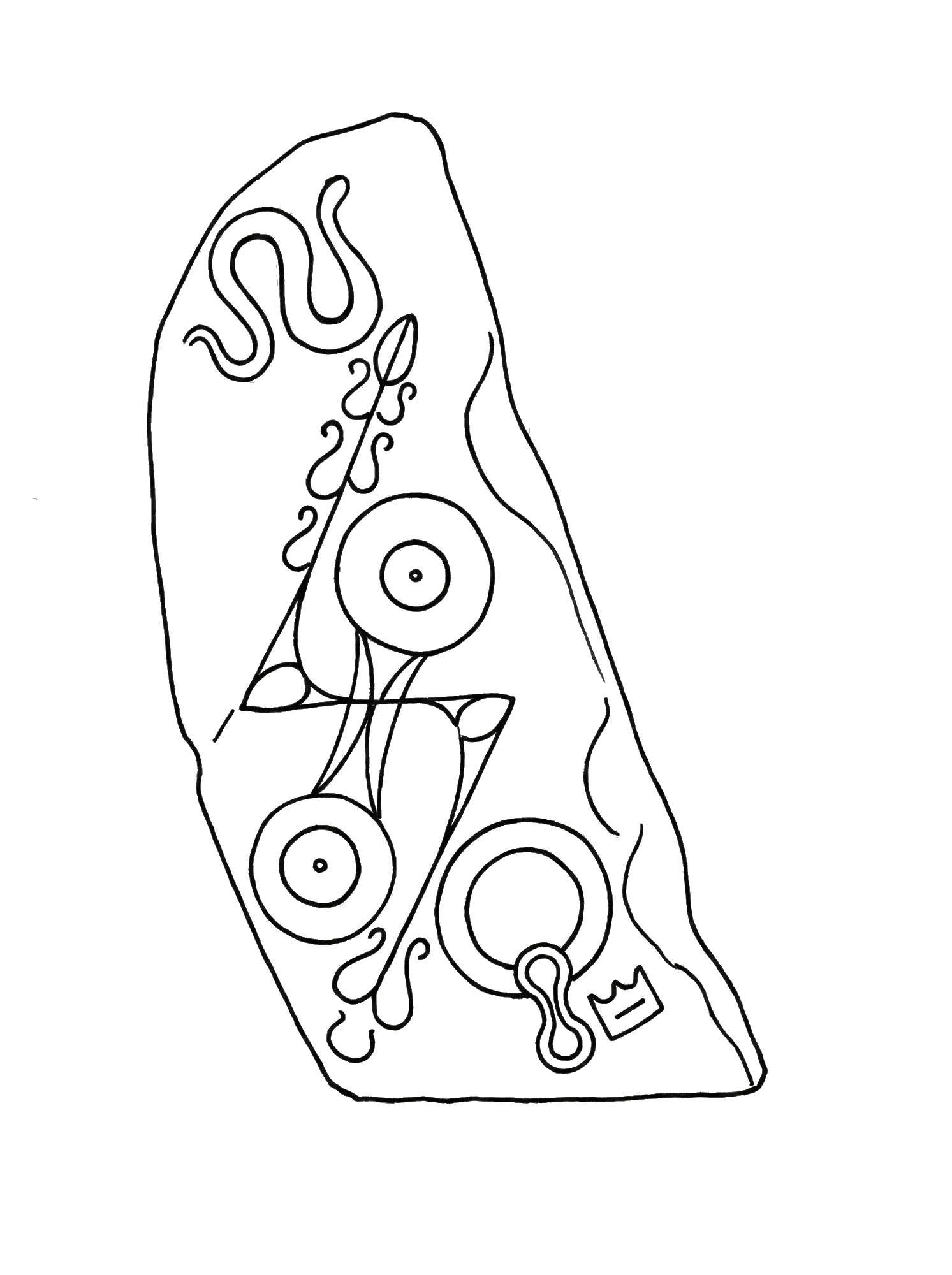
"Shapes I can't name. Crescents with arrows through them, broken into angles. Paired circles connected by zigzag lines. Rectangles with notches, nested like partitions." He was shaking now. "And animals. But not normal animals. Things that shift. Fish that might be serpents. Beasts I can't identify—not horse, not elephant, not seal. Something with a long curved snout that moves like it's swimming through stone. Bulls with spiral joints at the hip and shoulder, like the muscle is coiling inward."
He looked up at her.
"And threading through all of it—serpents winding through everything, knotting around the other forms. Endless interlacing. It feels like it means something, but I can't read it. I've never been able to read it. So I made up a story about teachers, because I had to call the signal something."
Susan's mind was racing. Parallel data streams. Converging observations on the same forms.
"What else?" she asked.
"Presences. Not beings I can see clearly—just awareness. The sense of being documented by something very old." He met her gaze. "I called them teachers because that's what you call things that show you things. But they weren't teaching me anything. They were just… there. In the signal."
"I think we should keep talking," she said. "All three of us. Somewhere we can spread out. I want to see what you've been drawing. I want to map your zigzags against my transects."
David was still staring at the screen, at the frozen spirals he'd been receiving for six years without knowing they were written in buckwheat and serpentine soil.
"I drew crescents and beasts with spiral joints," he said, almost to himself. "Hundreds of drawings. And I told people they were transmissions from higher consciousness. But they're here. Growing in the dirt."
The sun broke over the hills, flooding the pool with gold. Steam rose around them, minerals surfacing from depths where fault lines had cracked the earth open.
Susan felt the ground shift in a way that had nothing to do with geology.
Something was beginning. She had no idea what.