Chapter
BEAR VALLEY
1,574 words · 8 min read
The road to Bear Valley wound through oak woodland and dry grass, the kind of California landscape that looked gentle until you tried to walk it. Susan drove, her Subaru handling the ruts with the familiarity of long use. David rode shotgun, the Raman spectrometer case between his feet.
"My usual plots are at McLaughlin," Susan said. "Twenty miles east. Normal variation. Noise. What you'd expect." She downshifted for a steep grade. "Bear Valley's different. The fault exposure gives access to deeper formations. Same geological complex as Wilbur Hot Springs—when Jennifer told me where Starseed has his visions, I looked up the stratigraphy. Same formations."
David absorbed that. The hot springs and the plant shapes. Same geology. Different expressions.
They parked where the road gave out. The outcrop was visible from here—darker than typical serpentine, more complex. Layers of different ages compressed and tilted by the fault.
Susan was already moving up the slope with an ease that made his gym fitness feel like a joke. David grabbed the spectrometer case and followed, breathing hard within the first hundred meters.
"The buckwheat colonized here maybe fifty years ago," she said without slowing. "Opportunists—they'll grow anywhere the chemistry doesn't kill them. I started monitoring in 2021, looking for comparison data."
The slope leveled into a broad shoulder. Low, silver-green plants dotted the thin soil between exposed rock.
"This is the edge," Susan said. "Normal variation starts here. See how the phenotypes scatter? Different heights, different leaf shapes, no obvious organization."
David crouched, studying the plants. Patchwork. Noise.
"Now walk with me."
They moved upslope, Susan leading along a contour line she seemed to know by instinct. The vegetation changed gradually—still buckwheat, still serpentine-adapted, but something in the distribution was shifting. A feeling of alignment at the edge of perception.
Then they crested a small rise, and he saw it.
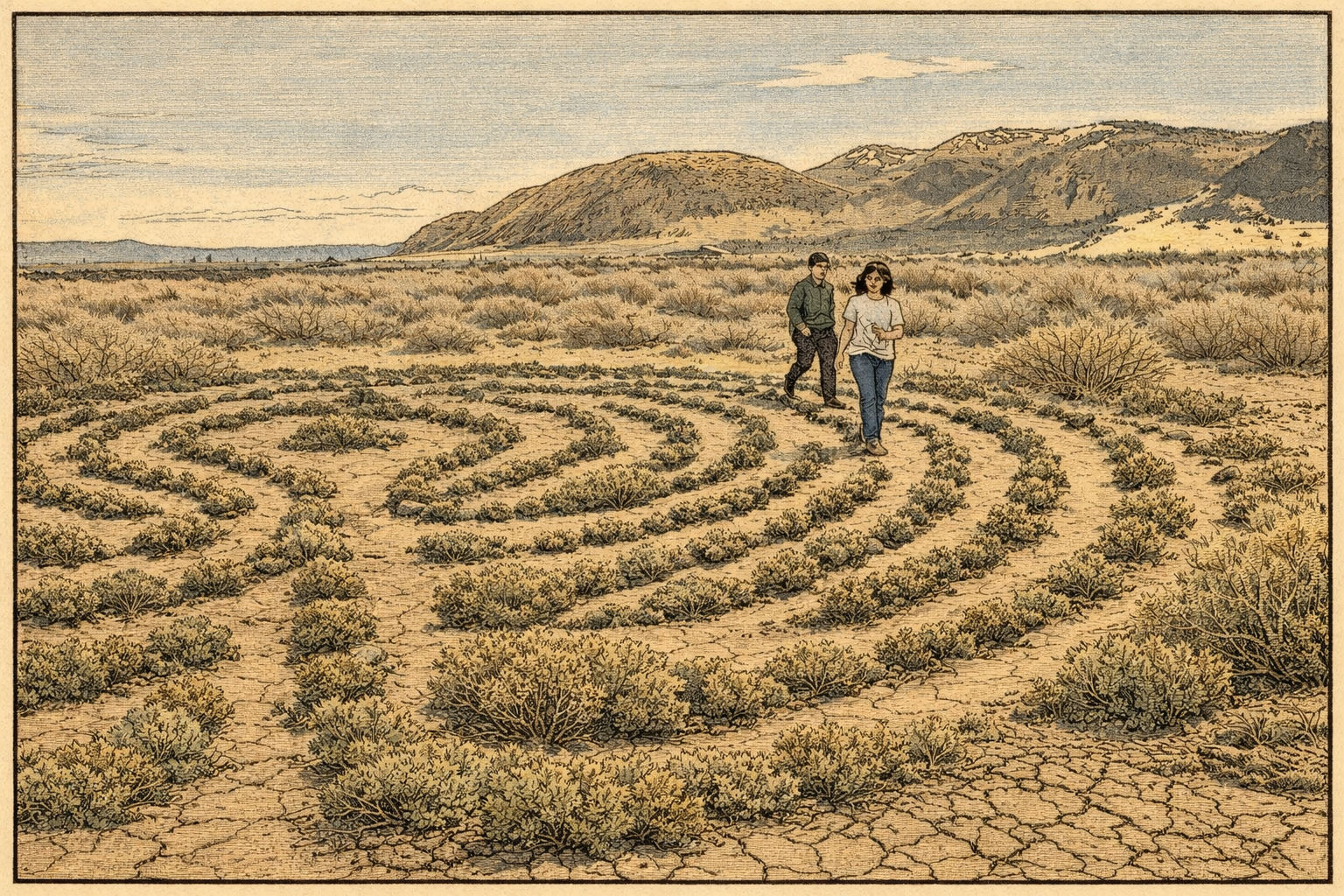
The drone footage hadn't prepared him. From the air, the curves were abstract—beautiful, strange, but flat. From inside it, standing in the middle of the largest spiral, he felt it in his body. The plants curved around him in sweeping arcs, phenotypic variation tracking invisible contours like iron filings around a magnet.
"Jesus," he said.
Susan stood beside him, arms crossed. "That was my reaction too. First time I flew the drone over this section and saw what I'd been walking through without seeing."
"It's not subtle."
"It's not subtle from the air. From the ground, your brain doesn't integrate it because you're not looking for organization at this scale." She gestured at the sweep of vegetation. "Thirty meters across, the main spiral. The secondaries are smaller. It repeats down to the resolution limit of my imaging."
David was already unlatching the spectrometer case. "Raman spectroscopy," he said, answering her look. "Hit a sample with a laser, measure the scattered light. Different molecular arrangements scatter differently—unique spectral fingerprints. I can identify minerals in situ."
"What are you looking for?"
"I don't know yet. That's the point." The device beeped ready. "Show me the transect. Inside the spiral, then outside. I want to see if there's a chemical signature that correlates."
They worked across the slope, David stopping every few meters to press the sensor against exposed rock, soil, the base of plants where roots met substrate. Susan pointed out features—boundaries between soil types, areas where the curves intensified, patches where they broke down.
Standard serpentine signatures. Olivine, pyroxene. Nothing unusual.
Until they reached the center of the spiral.
David pressed the sensor to an outcrop and watched the spectral readout spike in a way he'd never seen in field conditions. He ran it again. Same result.
He stared at the screen. He knew this signature—not just the elemental composition, but the organizational complexity. He'd spent years working with materials that produced readings like this. Engineered crystals. Carefully synthesized substrates. Samples that cost thousands of dollars per gram.
Not something you found in a California hillside.
"What?" Susan said.
"Iridium." He heard his own voice go flat. "There's an iridium signature here. But that's not what's strange."
"Iridium? That's—"
"A platinum group element. Extremely rare in Earth's crust. The main natural source is meteoritic—asteroid impacts. You find it at the Cretaceous-Paleogene boundary worldwide because of Chicxulub." He ran the sensor across the outcrop again. "It shouldn't be here. Not at these concentrations, not in California coastal ranges. But Susan—the concentration isn't the anomaly. It's the organization."
She crouched beside him. "What do you mean?"
"Natural iridium deposits are disordered. Random crystallographic orientation. This—" He pointed at the readout. "This shows hierarchical ordering. Layers within layers. Like something has been building on itself for a very long time."
"Building how? Iridium doesn't grow."
"No. But complex systems self-organize." David thought of a paper he'd read years ago. "There's a physicist named Anderson—Nobel laureate. He wrote something called 'More is different.' The idea that when you get enough of something interacting, new properties emerge. The whole becomes qualitatively different from the sum of its parts."
"Emergence. I know the concept. It's how ecosystems work."
"Right. But Anderson was talking about physics. Matter itself developing new properties at higher scales of organization." He turned the spectrometer over in his hands. "What if something like that is happening here? What if this material has been self-organizing for so long that it's become… something we don't have a framework for?"
His thoughts flashed to the detector array at Ames—the iridium-doped sensor matrix he'd spent years optimizing. He'd chosen iridium for its unique electronic properties, its ability to stabilize quantum states in ways other elements couldn't match. He'd always assumed that was laboratory chemistry. Artificial. Engineered.
What if it wasn't?
He walked ten meters outside the spiral's arc, pressed the sensor to another outcrop. The reading dropped to noise—not just lower iridium, but lower complexity. Random arrangement. He stepped back into the curved area. The spike returned.
"It tracks the boundary," he said slowly. "Present where your plants show the curves. Absent outside." He stared at the readout, then at the sweep of buckwheat. "But even highly organized iridium doesn't explain thirty-meter spirals in plant phenotypes. The material might influence chemistry at the molecular level, but the shape—that's something else. That's emergence at a scale the substrate alone can't account for."
Susan was quiet for a long moment. The wind moved through the buckwheat, silver-green leaves catching the light.
"So we have iridium that shouldn't be here," she said. "With organization that shouldn't exist. And curves in plants that can't be explained by either."
"Three anomalies. Possibly connected. Mechanism unknown."
"The CGR analysis," Susan said. "The organization in the non-coding DNA. Could iridium do that? Interact with genetic sequences?"
"At the molecular level, maybe. Platinum group elements can catalyze reactions, bind to proteins, bias how molecules fold." David paused. "But organizing DNA sequences into curves that mirror phenotypic distribution across thirty meters? That's not just chemistry. That's information processing at a scale I don't understand."
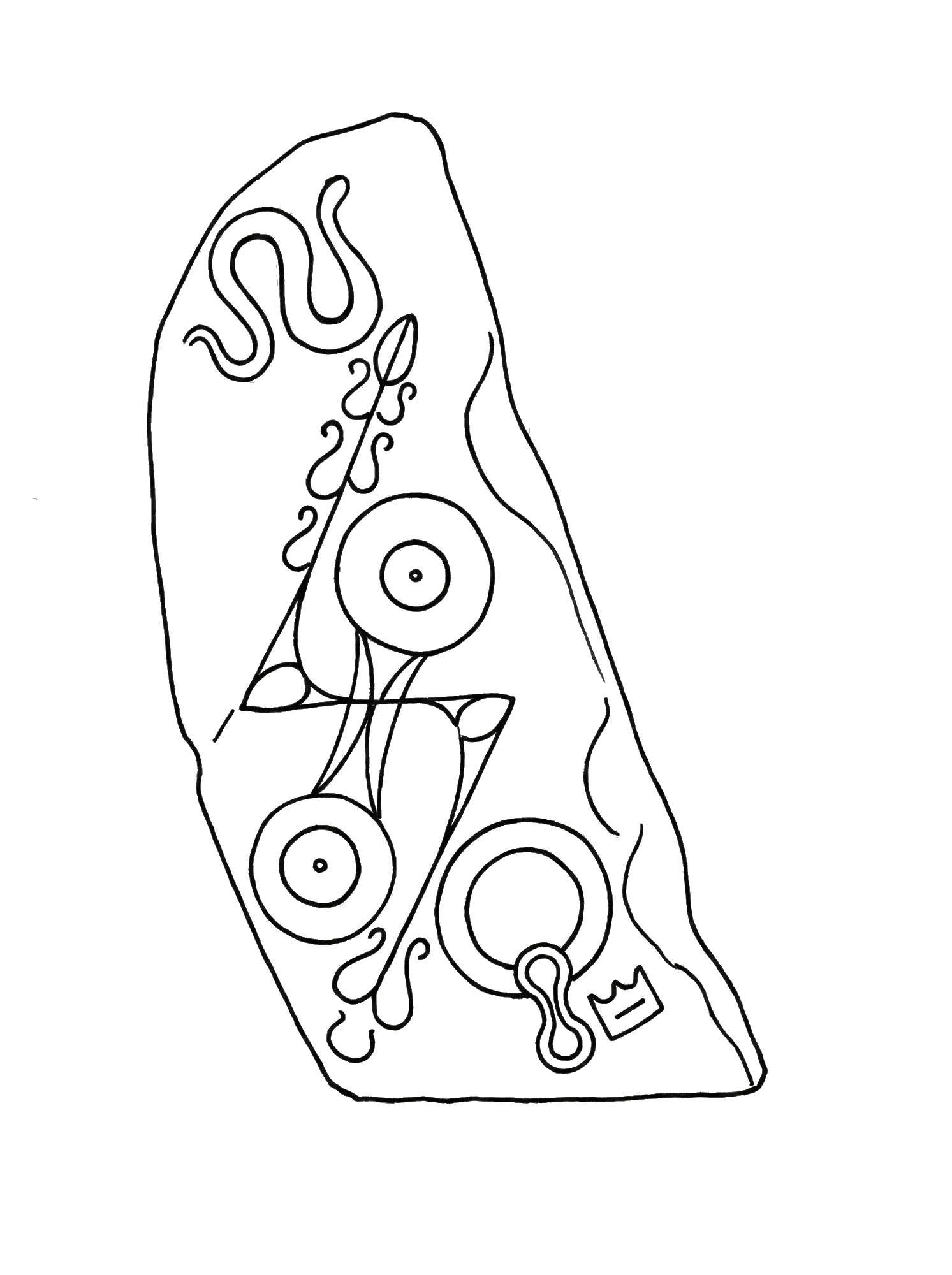
Something about these curves nagged at him. A half-memory—shapes he'd seen in another context entirely. He pushed it down. That was hobby. This was data. The two worlds didn't touch.
Except something was rhyming now.
Susan stood, brushing dirt from her knees. "I've been walking these plots thinking I was collecting comparison data. Standard serpentine work. And the whole time there was another element here I wasn't testing for."
"You couldn't have known."
"No. But I know now." She looked at him directly. "What do we do with this?"
"I need to make some calls," David said. "There's someone who might have context. A geologist at the Natural History Museum in London."
"She studies what?"
"Impact stratigraphy. Extinction boundary layers. She's been cataloguing platinum group element distributions for decades." He paused. "She's also noticed organizational anomalies she's never published. In formations separated by hundreds of millions of years. We've been trying to understand it together for a long time."
Susan absorbed this. "You know her how?"
"Through a historical research community. We were both studying"—he hesitated—"things that didn't fit our official frameworks. We found each other."
"Call her."
David pulled out his pocket knife, worked at the outcrop until a thumb-sized fragment came free. Dark, dense, unremarkable-looking. He pocketed the sample.
"I will. Tonight." He powered down the spectrometer, latched the case. "Susan, I came here hoping to find an error. A measurement artifact. Something that would make this go away."
"And instead?"
"Instead I found organized iridium where it shouldn't exist, correlating with curves it can't directly explain." He thought of Starseed's drawings. "And other things. Independent observations converging on the same forms, with no mechanism connecting them."
Susan started back down the slope. She stopped and glanced back at him, and for the first time since he'd met her, she smiled. Not humor—recognition. Two scientists standing in front of something that shouldn't exist, with nothing but the next question between them and the unknown.
"At least we have something to call it," she said.
"Do we?"
"We have a name. Iridium. And a direction—emergence, self-organization. That's more than we had yesterday."
She was right. A name was a handle. A way to grab hold of something and pull.
David followed her down the hill, the spectrometer case heavy in his hand, already composing the message he would send to Margaret Blackwood.