Chapter
THE BRIDGE
1,081 words · 6 min read
Jennifer watched her husband and Susan Harris circle the same impasse for the third time.
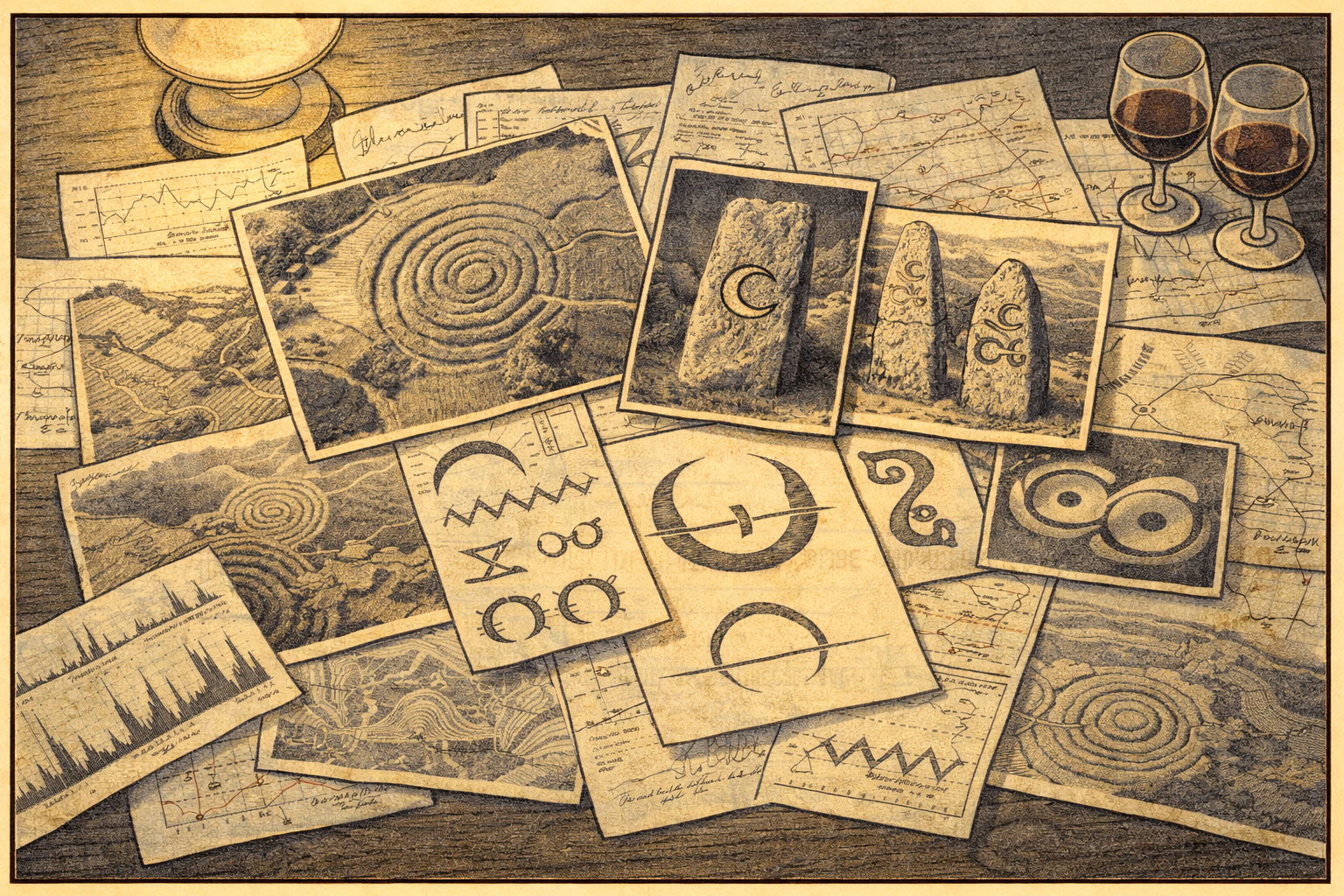
"The iridium concentrations track exactly with the phenotypic variation," Susan said, her eyes on the printouts spread across the dining table. Drone footage. Spectral analyses. Maps of Bear Valley. "There's no artifact. The correlation is real."
David nodded. He'd been quiet all evening—processing. He'd been like this since the phone call with Margaret, moving through the house with the stillness of a man whose understanding had cracked and was still deciding whether to shatter or reform.
"The correlation is real," he agreed. "But correlation isn't mechanism. The iridium explains why the plants might respond to something in the substrate. It doesn't explain thirty-meter spirals. Trace element chemistry doesn't produce organization at that scale."
"No," Susan said. "It doesn't."
Jennifer set down her wine glass. "I want to show you something."
Both scientists looked up. She was already moving toward the study, toward the folder she'd brought from Wilbur two days ago.
She returned and set it on the table between them.
"David, you remember I told you about Starseed. The man at Wilbur who's been having visions."
David's expression flickered—the careful neutrality of a scientist being asked to consider something outside his framework. "You mentioned him."
"He's been drawing what he sees. For years. Hundreds of drawings, reproduced exactly from memory weeks after the visions occur."
She opened the folder.
The drawings spilled across the table. Pencil on paper, all showing the same vocabulary of forms. Crescents bisected by angled lines. Paired circles connected by zigzag patterns. Rectangles with notched edges, nested inside each other. Curves that spiraled inward. And animals—strange, fluid creatures with joints that seemed to coil, bodies that suggested motion even in stillness.
Susan leaned forward, her breath catching. She looked at the drone footage. Looked back at the drawings.
"The curves. The nested scaling. This is the same—" She stopped.
"I know," Jennifer said.
David had gone very still. He was staring at one of the drawings—a crescent with a broken arrow through it, surrounded by interlacing serpentine lines. His face had drained of color.
"David?" Jennifer touched his arm. "What is it?"
He didn't answer. He stood and walked to his study. Jennifer heard drawers opening, papers shuffling. When he returned, he was carrying a folder of his own—older, the edges worn.
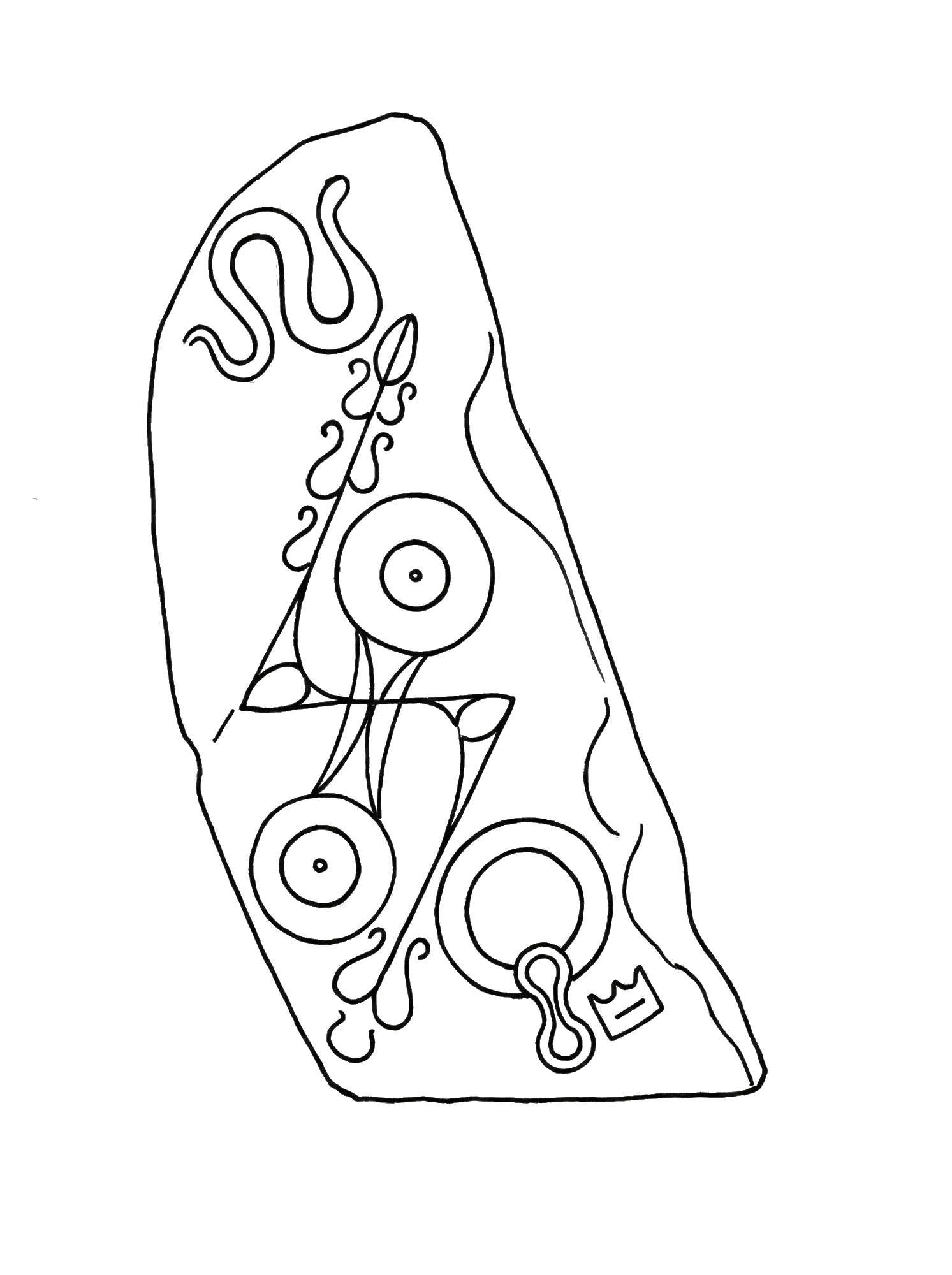
He set it beside Starseed's drawings and began laying out images. Stone carvings. Ancient monuments photographed in gray Scottish light.
"These are Pictish symbol stones," he said. His voice was strange—flat, controlled. "Class I monuments, carved between the fourth and ninth centuries in Scotland. The symbols have never been deciphered."
Susan looked from the photographs to Starseed's drawings. Her face went through something Jennifer couldn't read.
"The crescents, the spirals, the paired forms," Susan said slowly. "The mathematical relationships match. How is that possible?"
"He's never seen them," Jennifer said. "I asked him once if he'd studied Celtic art, ancient symbols. He laughed. Said his education stopped at community college and a lot of psychedelics."
David was still staring at the drawings, at the stones, at the resonance between them.
"How long have you known about this?" Susan asked him. "The Pictish connection?"
"Twenty years. Through a historical research community—a hobby, I always told myself. Separate from my real work." He almost laughed. "I've been living a double life. Physicist by day, amateur archaeologist by night. I wrote papers about the mathematical properties of the interlacement. I corresponded with scholars who saw the same strange regularities. I told myself it was intellectual curiosity."
"And now?"
David looked at his wife.
"Now a man in California is drawing forms that match thousand-year-old Scottish monuments. A botanist is photographing the same forms in plant distribution. My detector is reading coherent organization in minerals that shouldn't have any." He sat down heavily. "And Margaret has samples from five major extinction events showing the same signature. K-Pg, Permian-Triassic, Late Devonian, End-Ordovician. Across hundreds of millions of years."
The dining room was very quiet. Outside, the ordinary sounds of a Palo Alto evening—sprinklers, distant traffic, a dog barking.
"Four independent data streams," Susan said. "Plant phenotypes, mineral crystallography, neural visions, ancient carvings. All showing the same forms."
"And all connected to the same substrate. Iridium-bearing material at Bear Valley, at extinction boundaries worldwide, in the geology under Wilbur Hot Springs." David paused. "The Pictish stones cluster at locations where similar formations approach the surface. Margaret's been mapping that correlation for years."
Susan was quiet for a long moment.
"I've spent my career being skeptical of exactly this kind of convergence," she said finally. "Patterns that turn out to be coincidence, artifact, wishful thinking."
"And now?"
"Now I'm looking at drawings that echo both my aerial surveys and thousand-year-old Scottish monuments. And the underlying mathematics is too consistent. The correlation is too strong." She looked up. "Something is actually there."
"That's where I am too," David said.
"So what do we do?"
Jennifer had been waiting for this.
"We go to Wilbur," she said. "All of us. You, David. Susan. Starseed. We bring the data together in the place where the signal is strongest."
"That's not very scientific," Susan said, but there was no objection in her voice.
"Neither is any of this." Jennifer met her eyes. "You've got forms in plants that shouldn't exist. David's got crystallography that shouldn't exist. Starseed's got visions that follow the same forms found in symbols he's never seen. Whatever this is, it's not going to fit a conventional protocol."
David was looking at her with an expression she knew well—the look he got when she'd seen something he'd missed.
"I need to send equipment to London first," he said. "Margaret has samples I can't access any other way. Amara can run the analyses on site. But that's going to take time."
"Then we work in parallel. I'll set up Wilbur for next weekend. Susan, can you bring your full dataset?"
"Everything. Drone footage, CGR analysis, soil chemistry." Susan paused. "I should warn you—I'm still a skeptic."
"So am I," David said. "That's the point."
Jennifer began clearing the wine glasses, leaving them with their data and the impossible convergence that connected a man's visions to ancient stones to a planet's deep history.
Next Saturday. Wilbur Hot Springs.
The pieces were finally in the same room. Now they just had to see what they made.