Interlude
Galapagos — Darwin Timestream
1,072 words · 6 min read
GALÁPAGOS, SEPTEMBER 1835
The finch was unremarkable.
Charles turned it in his hands, examining the beak—heavy, blunt, built for crushing. He had shot it an hour ago on the slopes above James Bay, one of dozens collected since the Beagle dropped anchor in this volcanic archipelago two weeks prior. The specimens accumulated in his cabin: finches, mockingbirds, tortoises, marine iguanas that looked like dragons designed by a naturalist with a fever. He labeled them by island when he remembered, though he had not been systematic about it. The birds all looked similar enough. Variations on a theme.
The sun pressed down. The volcanic rock radiated heat like a forge. Charles had been warned about the Galápagos—the whalers called them Las Encantadas, the Enchanted Isles, though enchantment seemed the wrong word for this brutal landscape. The vegetation was sparse, thorny, drought-adapted. The animals showed no fear of humans, which made collecting easy and left Charles with a peculiar guilt he did not examine closely.
He set down the finch and picked up another from his collecting bag—this one from Chatham Island, where they had first made landfall. The beak was different. Longer, more pointed, built for probing rather than crushing. He held the two birds side by side, frowning.
Different islands. Different beaks. The same bird? Or different species entirely?
He did not know. That was the problem with this voyage—it generated questions faster than answers, accumulated mysteries like the specimens accumulating in the Beagle's hold.
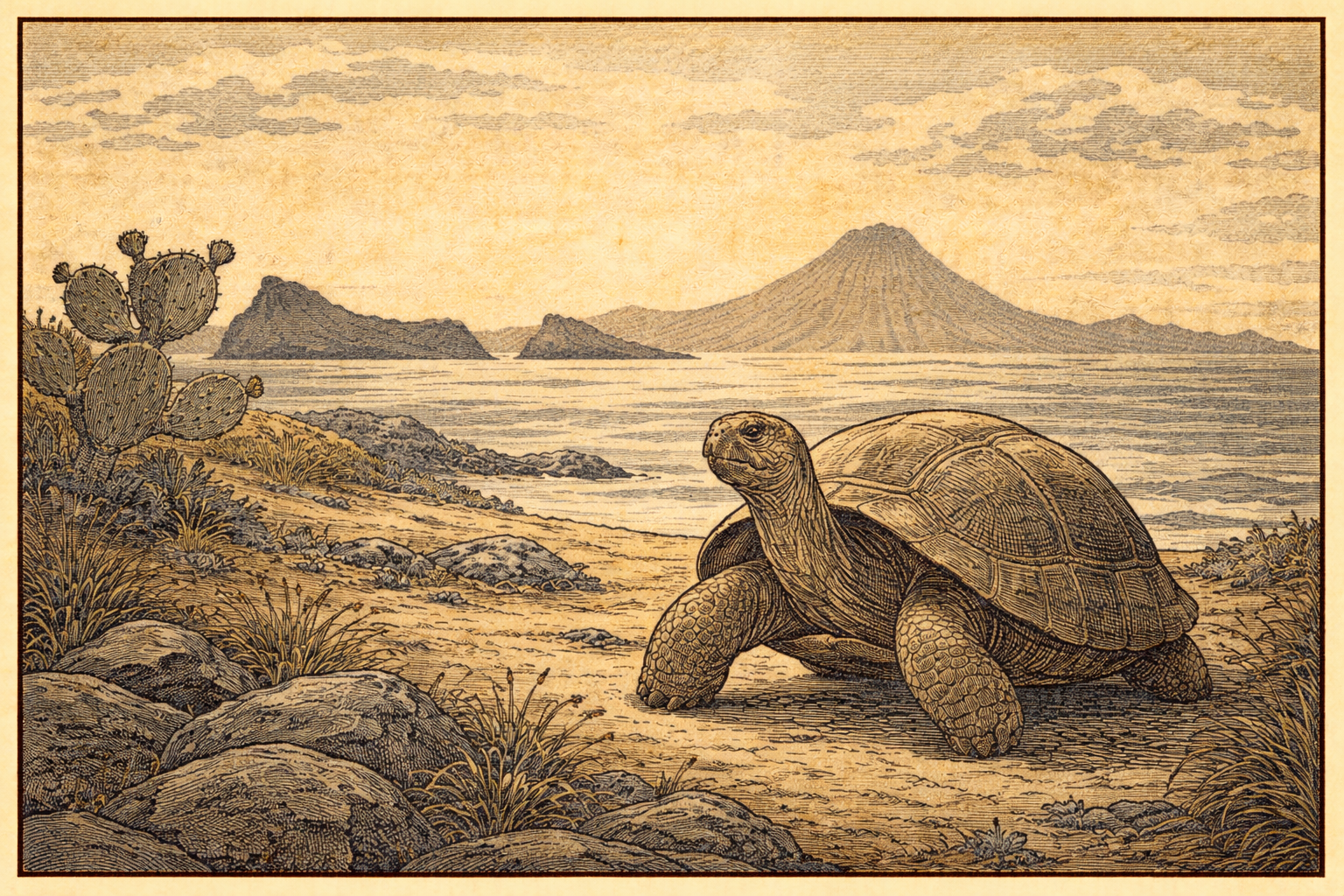
The giant tortoises had unsettled him most.
He had ridden one, briefly—a foolish tourist's gesture he would not include in his official notes. The creature had been enormous, ancient-seeming, its shell scarred by decades of volcanic rock and thorny vegetation.
The Vice-Governor of the islands, Mr. Lawson, had made an offhand comment that lodged in Charles's mind like a splinter. The man claimed he could look at any tortoise and tell which island it came from by the shape of its shell alone. Domed shells on the wet highlands, saddleback shells on the arid lowlands. Each island had its own form.
Charles had not been systematic about recording which tortoise came from which island. An oversight that now seemed significant. If the forms varied predictably by location—if that held—what did it mean?
He thought of the bones at Punta Alta. The giant ground sloth that resembled the small sloths still living. The armored Glyptodon that echoed the armadillos rolling across the pampas. Dead giants and living diminutives, sharing architecture across whatever gulf of time separated them.
Here it was again. The same relationship, but in space rather than time. Living creatures, separated by a few miles of ocean, diverging into distinct forms. As if the islands were laboratories running parallel experiments on the same raw material.
What mechanism could produce such variation?
He had no answer. Only the question, growing sharper with each specimen he collected.
That evening, he walked the shore as the light failed.
The marine iguanas clustered on the black rocks, their dark bodies absorbing the last heat of the day. They were grotesque things—"imps of darkness," he had called them in his notes, though the phrase felt uncharitable now. They were superbly adapted to their environment. Unique in all the world. A lizard that swam in the sea and ate algae, its flat snout perfect for grazing underwater rocks.
Found nowhere else. Like the tortoises. Like the finches with their varying beaks. Like the mockingbirds that differed subtly from island to island.
The Galápagos seemed to generate uniqueness the way other places generated sameness. Every island a separate cabinet of curiosities, stocked with creatures that resembled each other and yet did not.
Not someone, he corrected himself. Something.
What something? He did not know. Could not name it. But he could feel it working beneath the surface of what he observed—a principle, a force, a law of nature as real as gravity and as invisible.
He picked up a stone from the beach—dark basalt, volcanic, still warm from the day's sun. The islands themselves were young, geologically speaking. Lyell's principles told him that much. These islands had risen from the sea recently. Thousands of years, perhaps. Tens of thousands at most.
And in that time, life had colonized them. Had varied. Had become something new.
How fast could such changes occur?
The question was almost heretical. The fixity of species was doctrine. Linnaeus had classified creation as if cataloguing a finished work. Species did not change; they simply were, had been since the beginning, would be until the end.
But the finches. The tortoises. The mockingbirds differing by island.
Charles put the stone in his pocket—habit now, collecting fragments of every landscape he visited. His cabin was cluttered with rocks, bones, pressed plants, pickled specimens. The archive of his voyage, waiting to be sorted, studied, understood.
The sun touched the horizon. The iguanas settled into stillness. Somewhere in the hills, a tortoise was walking its ancient path, carrying a shell shaped by an island shaped by a volcano shaped by forces that operated on timescales no human could witness.
Descent, Charles thought. The word surfaced unbidden. With modification.
He did not know what it meant yet. Would not know for years. But standing on the shore of James Island as the equatorial night came down fast and absolute, he felt the shape of something vast. The tortoises and finches and mockingbirds were evidence of a process. The bones at Punta Alta were evidence of the same process operating through time.
Creation was not finished. It was ongoing.
He walked back toward the ship's boat, his pockets full of stones, his mind full of questions. The stars emerged—different stars than England's, southern constellations he was still learning to name.
Among the basalt fragments he'd collected, one stone was older than it appeared—a remnant worked into the beach sand by waves and time from sources he would never trace. He would carry it back to England with all his other specimens, where it would sit in a drawer, unexamined, waiting.
The earth remembers. It was what the earth did.
Charles Darwin climbed into the boat, and the sailors rowed him back through darkness toward the Beagle.
He was twenty-six years old, assembling evidence for an argument he could not yet make.