Chapter
THE PREPARATION
1,082 words · 6 min read
Amara arrived at the lab before dawn, the way she always did when a problem wouldn't let her sleep.
David's request had come in at eleven PM—iridium anomalies in California geology, crystallographic ordering across extinction boundaries, a colleague in London with twenty-seven years of samples waiting to be tested. Get there before the end of the week.
She'd said yes because that's what you said when a MacArthur Fellow asked if physics was possible. But overnight, the engineering challenges had multiplied in her head.
The lab was quiet at six AM. Amara laid out her tools with the precision of someone who'd learned that carelessness cost time, and time cost opportunities, and opportunities didn't come twice to postdocs from South London.
The problem was simple to state, brutal to solve: David's full array filled half a room. She had to build something that would fit in carry-on luggage.
The portable spectrometer David had taken to Wilbur could measure iridium concentration. That was straightforward chemistry. But concentration wasn't enough. David wanted to read the same ordering he'd detected at Bear Valley—the periodicity that his lab array had found in geological samples.
"You want a portable crystallographic analyzer," she'd said when he called. "Battery-powered. Capable of detecting nanoscale ordering in natural specimens."
"Can you build it?"
"In three days?"
"Margaret's waiting. She's been waiting for years."
Amara had hung up and stared at her workbench for a full minute before reaching for her design notebooks.
The core challenge was maintaining signal integrity outside a controlled environment. David's lab array used vacuum chambers, vibration damping, temperature control within millikelvin tolerances. None of that would fit in a travel case.
But her iridium-aerogel matrix had been designed to solve exactly this problem. Room-temperature stability, clean signal propagation. She just had to push it further—make it capable of reading external samples, not just engineered substrates.
By noon, she had the architecture sketched. Miniaturized aerogel as the sensing element. Focused laser probe. Adaptive optics to find the active regions in messy natural specimens and lock onto them.
"Like tuning a radio to find a station," she muttered, sketching coupling geometries. "Except nobody's built the right receiver before."
David appeared around two, carrying coffee for both of them.
"How's it coming?"
"Ask me in twelve hours." Amara accepted the coffee without looking up. "The sensing element is straightforward. The coupling is the problem. Natural samples won't have clean interfaces."
"Margaret's specimens are museum-quality."
"Museum quality means no contamination. It doesn't mean optimal coupling geometry." She finally looked up. "I can build something that will work. I can't promise it will match your lab array."
"Better than samples sitting in drawers indefinitely."
Amara studied his face. In three years of working together, she'd learned to read his moods—the focused intensity when a problem was tractable, the brittle frustration when it wasn't. This was something else. Something that looked almost like desperation.
"What exactly am I looking for?"
David sat on the stool across from her workbench. "Organized ordering at the nanoscale. Regular intervals with systematic variations. Like something wrote data into the material and it's been sitting there waiting to be read."
"From what source?"
"That's what we're trying to find out. Margaret has samples from five major extinction boundaries. If the same ordering appears in all of them—"
"Then it's not local. It's global."
"And old. Hundreds of millions of years old." He met her eyes. "I know how this sounds. But the data is real. I need to know if Margaret's samples show the same thing."
Amara was quiet, thinking through the implications. It sounded like the setup for a science fiction novel, not a research program.
But David Mitchell didn't chase fantasies. His work had seemed outlandish until it made the cover of Nature.
"I'll build you a detector," she said. "If Margaret's samples have the same ordering as Bear Valley, I'll find it."
"That's all I'm asking."
"No, it's not." She allowed herself a small smile. "You're asking me to confirm that geology has been quietly wrong for a hundred and fifty years. But I'll start with the hardware and see where we end up."
By midnight, the prototype was assembled.
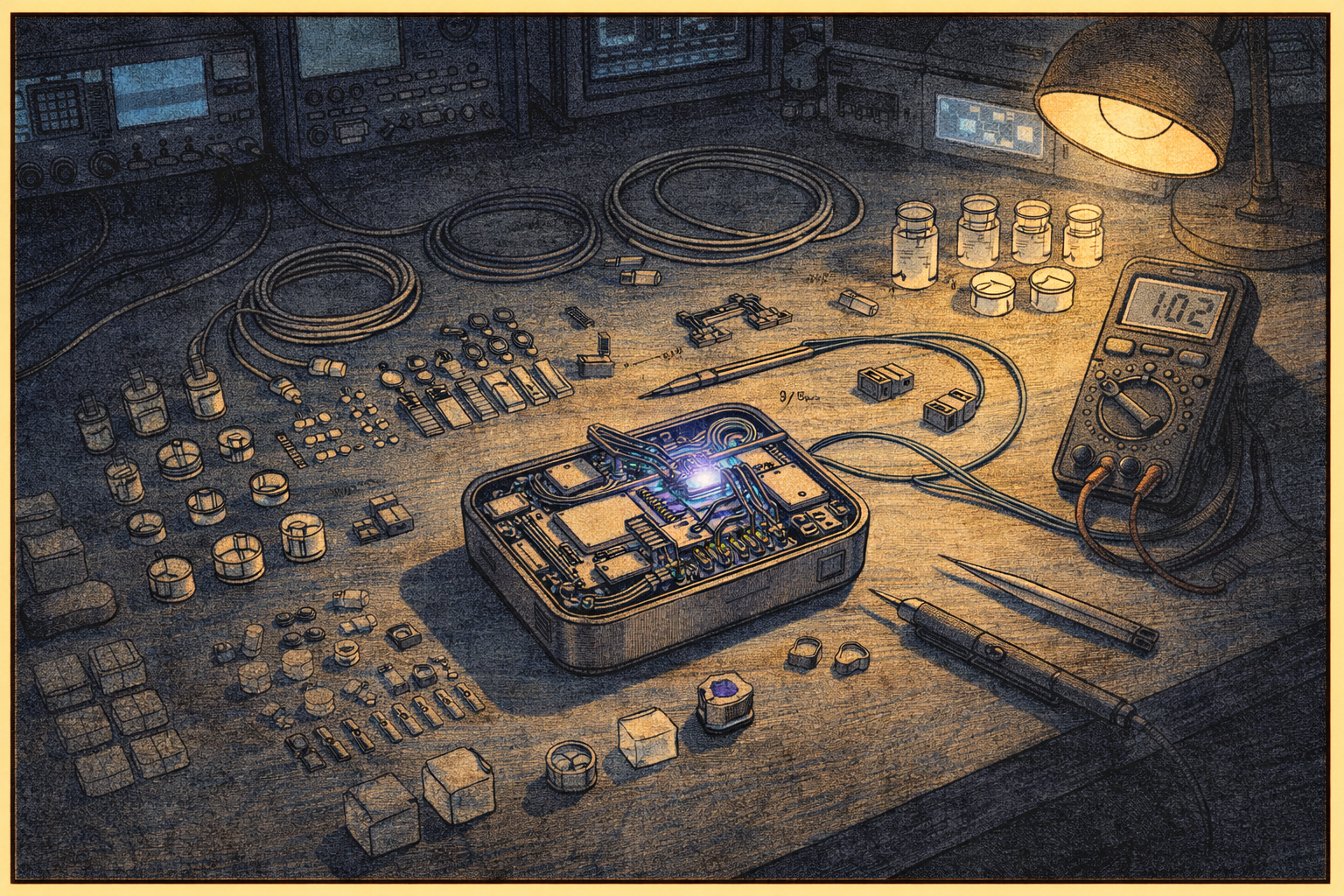
It wasn't elegant—a blocky case the size of a large laptop, cables protruding at awkward angles. The sensing element glowed faintly under UV illumination. The laser probe was repurposed from a biomedical scanner. The detection electronics were a compromise between sensitivity and portability.
Calibration tests using engineered samples read cleanly. Good. The core physics worked.
But engineered samples were optimized for clean interfaces. Natural specimens were another matter.
She opened David's sample storage and selected a fragment of Bear Valley material about the size of her thumbnail. Dark, irregular, nothing like the precise geometries she usually worked with.
The adaptive optics took nearly a minute to find coupling, scanning across the surface until the signal locked. Amara watched the readout stabilize.
Ordering. Clear and unmistakable. Periodic variations at the nanoscale that looked like—
She stopped herself. Confirmation bias was the enemy of good science.
She ran the test again with a different fragment. Different surface, different coupling characteristics. The readout was nearly identical. Same periodicity, same variation, same impossible organization.
"Bloody hell," she said softly, alone in the midnight lab.
A third sample. A fourth. Each showed the same underlying signature—not identical in every detail, but consistent. As if the Bear Valley material all contained the same fundamental information, expressed differently in each fragment.
Amara sat back and stared at her prototype.
She could dismiss it as artifact. Instrument error. That would be the safe interpretation—the one that let her keep her existing framework intact.
But the data was clean. The calibration was good. And David's lab array had found the same thing using completely different architecture.
She typed a message: Prototype operational. Bear Valley samples confirm ordering. Ready for London.
Then added: This better not be elaborate prank. Will be very cross if flying to London for nothing.
The reply came in seconds: Not a prank. Get some sleep. Flight's at 6 PM tomorrow.
Amara looked at the prototype, at the sample still glowing faintly in its coupling mount. Tomorrow she'd pack it carefully, cushion it against airline baggage handling, and carry it across the Atlantic to a museum basement where years of impossible samples were waiting.
She wasn't sure what she believed. But she was sure she wanted to know.