Chapter
THE OBSESSION WALL
1,351 words · 7 min read
The house in Palo Alto was older than Amara had expected—Craftsman-style, built when California still remembered it was part of the West rather than the future. Oak trees in the front yard, a porch that looked actually used.
"Jennifer found it," David said, reading her expression. "Before we were married. She said the bones were good."
Margaret was already on the porch, the padded case containing the Rhynie artifact held close. She hadn't let it out of her sight since Aberdeen.
The door opened, and there was Jennifer Mitchell—tall, sun-weathered, moving with the easy grace of someone who lived in her body rather than just occupying it.
"Dr. Blackwood." Jennifer took Margaret's hands. "I've been waiting to meet you for fifteen years."
"You've been reading our correspondence?"
"God, no. David's private obsessions stay private." Jennifer smiled. "But I know when something matters to him. And you've mattered for a long time."
The house was comfortable rather than decorated—furniture chosen for use, books everywhere. Jennifer led them through to a kitchen where something simmered on the stove and a bottle of wine stood open.
"Sit. Eat. We can talk about saving the world after you've had some protein."
Dinner was simple and good. They talked about Alasdair and the excavation, about the readings at Rhynie. David listened intently, asking technical questions about the coherence values. Jennifer listened differently—not for the data but for the meaning.
"So the Pictish keepers were real," she said. "Not just carvers. Curators."
"That's what the artifact suggests." Margaret set down her wine glass. "Someone recognized which crystals mattered. And when the kingdom fell, someone hid the most important one rather than let it be lost."
David had been quiet through most of dinner. Now he pushed back from the table.
"There's something I need to show you both," he said. "Something I've never shown anyone except Jennifer."
The home office was at the back of the house, a converted sunroom. David flicked on the lights, and Margaret stopped in the doorway. Amara nearly walked into her.
The wall.
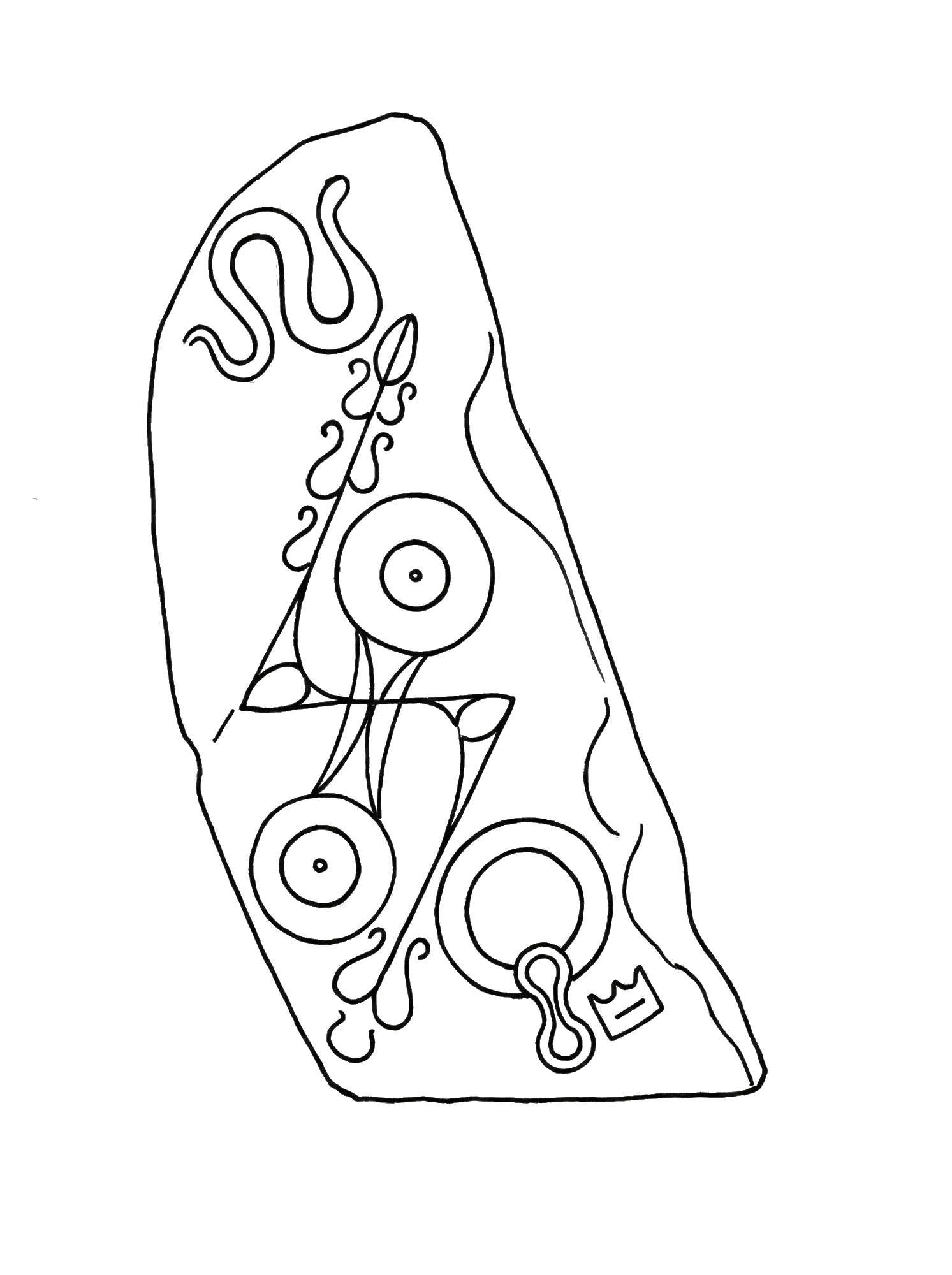
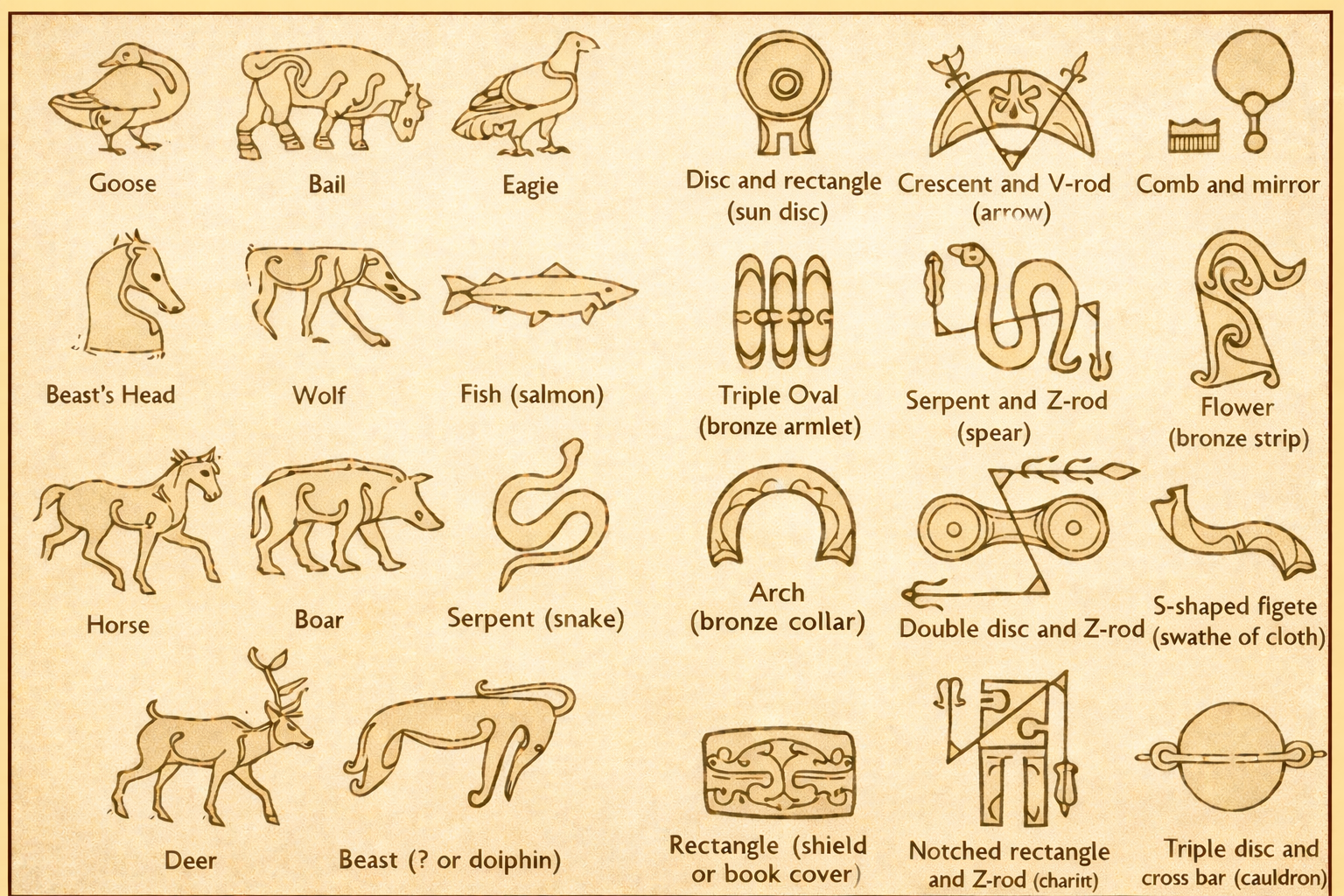
Twenty years of accumulated research covered the entire north wall, layered and interconnected. Photographs of every major Class I stone: Aberlemno, Dunfallandy, the Meigle collection. Distribution maps with pins and string. Geological overlays marked with handwritten annotations. Comparative charts showing symbol frequency and co-occurrence.
And threading through all of it, his own analysis: attempts to decode the grammar, to find the pattern, to understand what the symbols meant.
"Twenty years," David said. "I started this wall in 2004, the year after I joined the SCA. I thought if I just looked at it long enough, the meaning would emerge."
Margaret stepped closer. Amara hung back, feeling like an intruder on something private. This wasn't physics. This was faith.
"You mapped symbol frequency against site geology," Margaret said.
"Your suggestion. 2009, I think. After you published that paper on the Aberdeenshire formations."
"You never told me you'd done this."
"I never told anyone." He stood beside her, both of them looking at the wall. "The physicist and the Pictish researcher. I kept them separate because they didn't connect. Because there was no framework that could hold both."
"And now there is."
"Now there is." He turned to face her. "The detector output correlates with the symbol grammar, Margaret. I spent years convinced the stones encoded something real. And they did. They encoded what the carvers perceived at exposure sites—the same signal we're reading from the samples."
Margaret reached out and touched one of the photographs—the Aberlemno roadside stone.
"I grew up with these," she said. "The swimming elephant in my father's kirkyard." She'd told Amara the story on the train—the drowned fisherman, the empty grave, the symbol stone watching over it. Now Amara understood why that story mattered here.
"You chose rocks because they stay," Jennifer said softly from the doorway. "Because they hold history."
Margaret nodded. "I spent my career assuming the feeling at those sites was projection. My nervous system inventing significance." She gestured at the wall. "But now we're measuring something real. Something I was responding to without knowing what it was."
Amara thought of her grandmother's beliefs—ancestors watching, spirits attending. The things she'd dismissed as a physics student, certain that equations explained everything that mattered.
Maybe her grandmother had known something after all.
They moved back to the living room, coffee now instead of wine. David had pulled out his laptop.
"We have the anchor now," he said. "The Rhynie artifact gives us a high-resolution reference point. But we need calibration across multiple sources—different isotope ratios, different geological contexts—to determine if each sample responds differently."
"So we test each boundary sample against the Rhynie anchor," Amara said. "See if they respond differently."
"Exactly. Bear Valley, Margaret's boundary samples, Darwin's specimens, the Scottish Pictish sites—if they each respond differently, we're not just confirming global distribution. We're building a comparative data set."
"But comparative to what?" Amara asked. "We can measure coherence values, molecular organization. We don't know what any of it means."
"That's the problem." David leaned back. "We need a reference point. Something that responds to the samples in a way we can interpret."
"Starseed," Jennifer said quietly.
David nodded. "His visions correlated with iridium concentration in real-time at Wilbur. His drawings match Pictish iconography without ever having seen the stones. If we can put him in an fMRI while he's exposed to different samples, map his neural response against our detector output—"
"You'd have two data streams," Amara said. "The detector reading and the brain scan. Look for correlations."
"And the Pictish connection?" Margaret asked.
"The stones are at exposure sites. Starseed's drawings match the symbols. Either that's coincidence, or there's something about this material that produces consistent perceptual responses across fifteen hundred years." David spread his hands. "I don't know what that means. But I'd like to find out."
"He thinks he's receiving transmissions from ascended masters," Margaret said.
"His interpretation is wrong. But his neurology is responding to something measurable." David's voice was careful. "If we can show him the correlation—the data—maybe we can help him understand what he's actually experiencing. And in exchange, he helps us figure out what we're measuring."
The room was quiet.
"Can he handle it?" Margaret asked. "Having your worldview contradicted by data—that's not easy."
"He's already living with the contradiction," Jennifer said. "The morning at Wilbur, when the spectrometer showed his visions tracking with the iridium concentration—I watched his body change. He recognized the correlation. He's been carrying the dissonance ever since, waiting for someone to help him resolve it."
"Then tell him."
Jennifer shook her head. "It has to come from scientists with credentials and evidence. Coming from me, it's just another framework. Coming from you, it's truth."
"I'll call him tomorrow," she continued. "But we're going to need Susan too. Her botany, her field site, her career of understanding how this landscape works."
"It's ecology," Amara said. "Evolution. The living systems this material has been interacting with."
"Exactly." David looked around the room. "We're assembling a team. Different disciplines, different perspectives. Like the samples—each one tuned to a different part of the signal."
"When do we start?" Amara asked.
"Tomorrow. Amara, I need you to calibrate the array for the Rhynie artifact—those coherence values are going to stress the detection limits." He looked at Margaret. "And I need you to walk me through the boundary samples. Every one. Every context."
Margaret nodded slowly. "I've been waiting to share this for a very long time."
"Then let's not wait any longer."
They sat in the living room as the California night settled around them—three scientists and a bridge-builder, surrounded by evidence of something so large none of them could see its edges.
Before she went to bed, Amara slipped back to the office doorway and looked again at the wall. Twenty years of patterns, correlations, attempts to decode something that had resisted understanding.
We're close now, she thought. Closer than anyone's ever been.