Chapter
THE KEEPERS
1,759 words · 9 min read
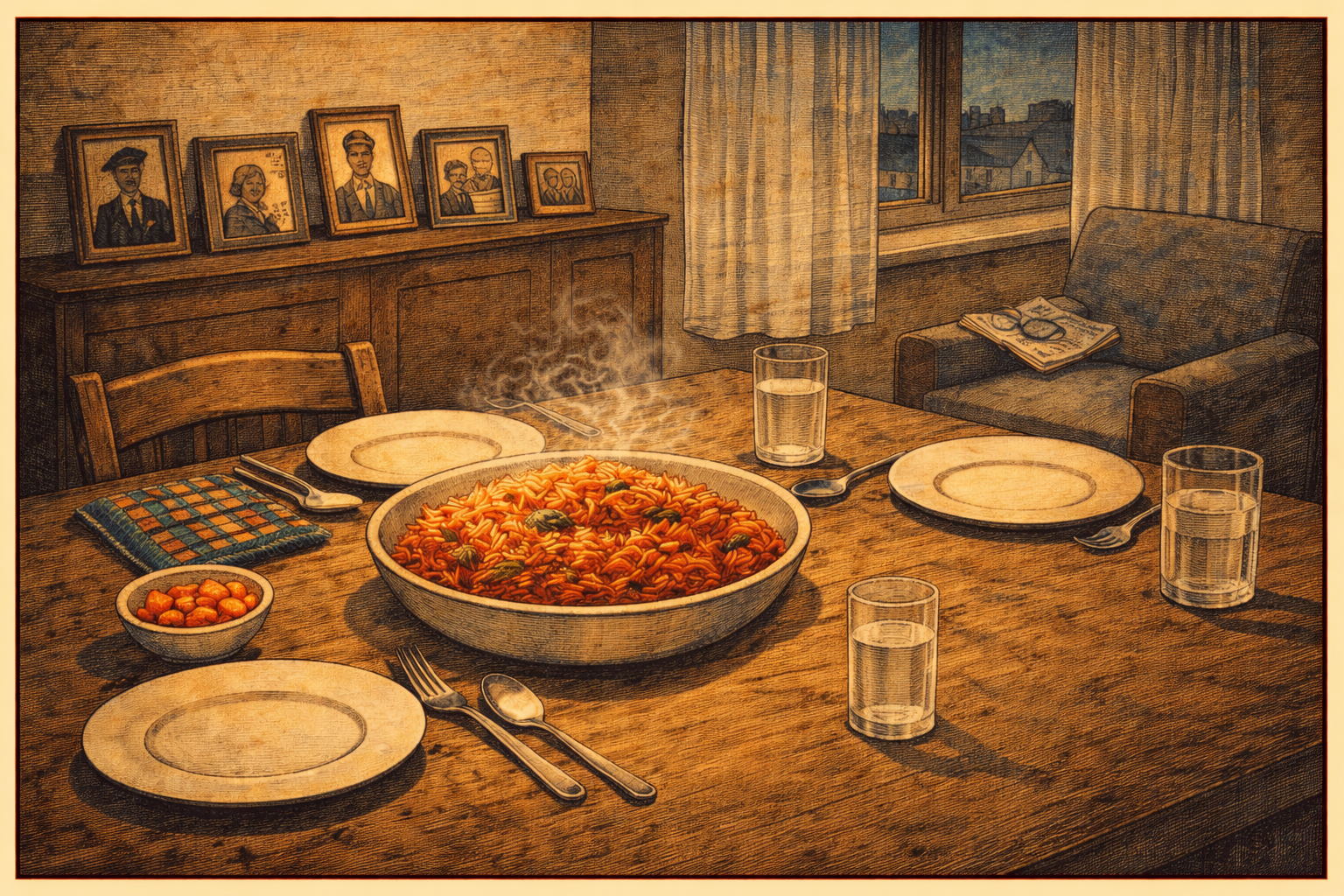
Amara's mother had made jollof rice.
The smell hit her the moment she walked into the Lewisham flat—tomatoes, scotch bonnets, the spice blend her mother had brought from Lagos forty years ago. Her father was in his chair by the window, reading glasses slipping down his nose. Her mother emerged from the kitchen, face breaking into a smile that made Amara feel twelve years old again.
"Look at you. So thin. They don't feed you in California?"
"They feed me fine, Mum."
Dinner was loud and warm and exactly what she needed. Her mother's questions about California. Her father's complaints about the council. The comfortable rhythm of family, unchanged since childhood.
She didn't tell them about the extinction boundaries. About Darwin's fragments. About ordering that had persisted for 445 million years.
Some things belonged to the work. Some things couldn't be translated into kitchen conversation.
But when her mother pressed leftover rice into her hands and kissed her goodbye, Amara carried something back to her hotel she hadn't brought with her. Grounding. The reminder that whatever strangeness she was uncovering, the world still contained jollof rice and parents who worried about whether she was eating enough.
The call came at seven the next morning.
"Amara. How quickly can you get to King's Cross?"
"An hour. Why?"
"Alasdair called. The Rhynie excavation." Margaret's voice was controlled, but something underneath—excitement, fear, both. "They found something in the ritual well. A crystal, mounted in silver. Pictish craftsmanship—the knotwork on the mounting is sixth century, maybe earlier. And the silver work incorporates symbol vocabulary. Crescent forms. The double disc proportions."
Amara was already packing. "How large?"
"Size of a fist. He sent photographs—the crystal itself has visible geometry. Not random fracture. Something organized."
"I'll be there."
The train north cut through British landscape—London sprawl giving way to Midlands industry, then Yorkshire moors, then the long climb into Scotland. Amara sat across from Margaret, the detector case between them.
They'd been silent for an hour when Margaret spoke.
"We're passing near Aberdeen soon. Where I grew up." She looked out the window at the passing hills. "There's a kirkyard there where my father is buried. Or where his stone is, anyway. The sea kept his body."
Amara waited.
"He was a fisherman. Went out one November and didn't come back. I was nineteen." Margaret's voice was matter-of-fact, the way people spoke about old wounds. "The kirkyard just has his name and dates and a line from a song he used to sing."
"I'm sorry."
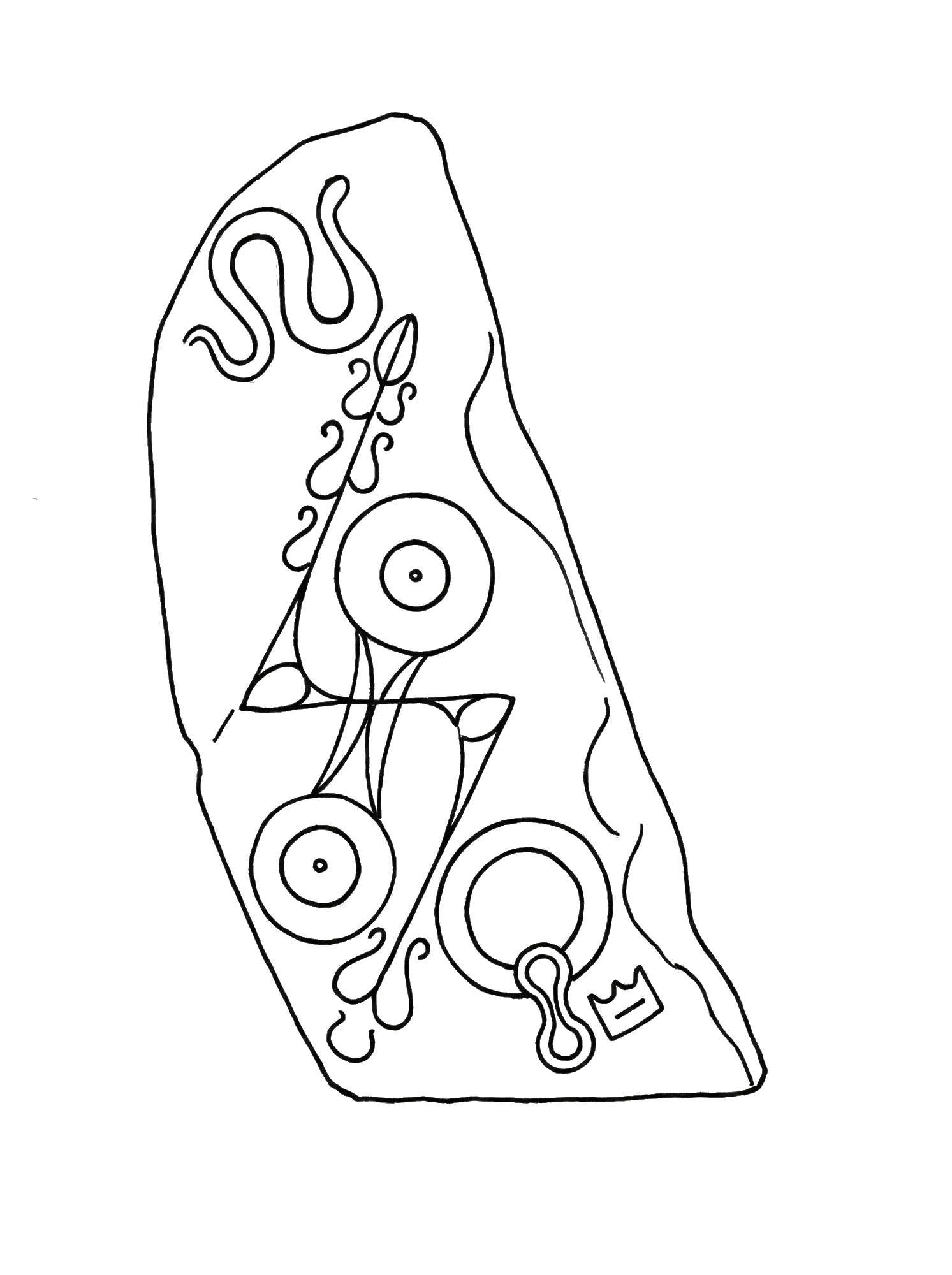
"Long time ago now." Margaret paused. "But there's a Pictish stone in that kirkyard. Class I, probably sixth century. Crescent and V-rod, double disc, a beast with spiral joints. I've walked past it a thousand times since I was a girl."
"And?"
"And one day—years after Da died, after I'd started finding the crystallographic anomalies—I stopped. Really looked." Her hands folded in her lap. "The spirals on the beast's joints. The proportions of the double disc. Something about the forms. I took photographs. Measurements. My sister watched me crawl around a gravestone with a tape measure and said nothing, which is her way of saying everything."
"You saw a connection."
"I saw something. The ordering in my samples. The symbol stones I grew up with. I thought I was imagining it—grief and obsession combining into pattern-finding." She shook her head. "But I started mapping anyway. Symbol stone locations against geological formations. The correlation was troubling. The Picts placed their stones where certain strata approach the surface. Exposure sites, geologists call them."
"Exposures of what?"
"I couldn't say. Not then." Margaret turned to face her. "That's when I started corresponding with David. Through the SCA—the Society for Creative Anachronism."
Amara blinked. "The medieval dress-up people?"
"The medieval dress-up people." Margaret's mouth quirked. "David's persona is Broichan maqq Kynat. A Pictish druid. I was Derelei ingen Nechtan—a Pictish noblewoman. We found each other through the research community, both obsessively interested in symbol stones, both seeing relationships we couldn't explain."
"David Mitchell. MacArthur Fellow. Quantum physicist. Dresses up as a Pictish druid."
"On weekends, yes." Margaret was almost smiling now. "The SCA gave us space to explore ideas that wouldn't survive peer review. Neither of us could let it go."
The train passed through a tunnel. When they emerged, the light had changed—softer, more northern.
"Twenty-seven years," Margaret said. "Twenty-seven years of hidden research, waiting for equipment that could read what I was measuring. And now we're going to find out if the connection I saw was real—or if I've been chasing shadows."
Rhynie was a small village at the edge of the Highland Boundary Fault. Alasdair Ross met them in the car park—a weathered man in muddy boots with the intensity of someone who'd spent decades listening to the ground.
"Margaret." He embraced her briefly. "And you must be the physicist."
"Materials scientist," Amara corrected. "Amara Okonkwo."
"I've been digging here since before you were born, probably." He gestured toward the site. "The well is this way."
They walked between trenches, Alasdair narrating. Rhynie had been a major Pictish settlement—high-status, ritually significant. The well was part of a ceremonial complex, its water considered sacred.
"The Viking-era layer was deliberate concealment," he said, stopping at a covered excavation. "Someone went to considerable trouble to hide what was underneath. They wanted it to stay hidden."
"Until now," Margaret said.
Alasdair lifted the tarp.
The well chamber was small, lined with fitted stones. Not water-filled as Amara had expected—centuries of silt had accumulated, leaving damp sediment at the bottom. Alasdair's team had excavated carefully down through the layers, and there, resting in a cleared section about a meter deep, was the artifact.
Amara's breath caught.
The silver mounting was extraordinary—interlaced knotwork in the distinctive Pictish style, cradling the crystal like a reliquary. And the crystal itself—
Even without instruments, she could see something. Not random fracture lines but geometry. Nested curves, periodic variations, forms within forms.
"Can I—" She gestured toward the detector case.
Alasdair nodded. "That's why you're here."
Amara set up the equipment with hands that weren't quite steady. She placed the sensor probe against the crystal's surface.
The adaptive optics locked immediately—no searching, no calibration needed. The signal was so strong that coupling was almost instantaneous.
The readout appeared.
Amara stared at it. Refreshed the display. Stared again.
"That's not possible," she said.
Margaret was at her shoulder. Her hand gripped Amara's arm.
"The coherence values," Margaret breathed.
"Off the scale. Literally." Amara pointed to the display. "The Bear Valley samples showed hundreds of nanoseconds. The extinction boundaries ranged from fifty to three hundred. This is reading over four thousand nanoseconds. More than an order of magnitude higher than anything we've measured."
She pulled up the complexity analysis. The number made her stomach drop.
"The molecular organization is beyond anything I've seen in natural samples." She looked at the crystal. "Beyond engineered samples, even. Whatever this is—"
She stopped. She didn't know how to finish the sentence.
"A thousand years in the ground," Margaret said quietly. "And coherence values an order of magnitude higher than anything else."
"The same material that appears at every impact boundary we've tested." Amara looked at the crystal. "And the Picts placed their symbol stones at outcrops where this strata is exposed. Whatever they were perceiving—whatever drew them to those sites—this is the strongest signal we've found."
Alasdair looked between them. "What is it you've found, exactly?"
Margaret and Amara exchanged glances. How to explain detector readings that shouldn't exist?
"Material with molecular organization beyond anything we've seen," Amara said finally. "It correlates with extraterrestrial impact sites—we've found the same signatures at extinction boundaries going back 445 million years. And the Picts seem to have recognized something about it. They marked the exposures with symbol stones. They preserved this crystal in a sacred well." She paused. "We don't know what it means yet. But this is the strongest signal we've measured, by far."
Alasdair looked at the crystal in its silver mounting, at the excavated well that had held it.
"Thirty years I've been digging Pictish sites," he said slowly. "I always knew they understood something we'd lost. The symbols, the sacred sites—it all suggested knowledge that didn't survive." He shook his head. "Now you're telling me there was something real here. Something they could perceive."
"Something they recognized as important enough to preserve," Margaret said. "And to hide, when the kingdom was falling."
Alasdair was quiet. The northern wind moved across the excavation.
"Margaret," he said finally, "I've trusted your judgment for fifteen years. If you tell me this artifact needs to go to California, it goes to California." He paused. "But you're going to explain everything. When you understand what I've spent my life excavating without knowing—you're going to tell me."
"I will," Margaret promised. "When we can explain it to ourselves."
Alasdair nodded toward the well. "We've only cleared the upper levels. There's more material below—I can feel it. Whatever they hid here, I don't think the crystal was all of it."
They drove back to Aberdeen in late afternoon light, the crystal secured in a padded case. Margaret made promises to Alasdair—documentation, proper protocols, academic credit. But underneath the professional obligations, something else was happening.
The pieces were accumulating. Bear Valley. The extinction boundaries. Darwin's fragments. Starseed's visions. The symbol stones. And now this—a Pictish artifact with readings that exceeded anything they'd measured.
"Book us on the first flight to San Francisco," Margaret said. "Both of us."
"Both?"
"This artifact doesn't leave my sight. I've been waiting my whole career to understand what I've been measuring." Margaret's voice was firm. "I'm not missing the answer because I stayed in London."
Amara looked out at the darkening Scottish landscape—the hills and lochs and ancient stones that had shaped Margaret's entire life. The kirkyard where her father's name was carved. The symbol stone that had watched over his empty grave.
"The Picts called it talking to ancestors," Amara said. "That's what the symbol stones were for, yes? Communicating with the dead."
"That's one theory." Margaret was quiet for a moment. "My grandmother believed in spirits. Ancestors watching, guiding. I stopped believing when Da drowned and nothing intervened."
She didn't say anything more. Neither did Amara.
The car moved through the Scottish twilight, carrying two women and an artifact they couldn't explain—only measure.