Chapter
THE ARCHIVE
1,414 words · 8 min read
They began at dawn.
Jennifer hadn't slept. She'd spent the night reviewing Starseed's physiological data, looking for a reason to call this off that would be strong enough to override his determination.
She hadn't found one.
Starseed arrived calm—calmer than at Tierra del Fuego, as if the decision had settled something in him. He'd done his breathing exercises, eaten lightly, hydrated. All of his years of visions had been preparation. Everything before had been tuning the instrument.
"The tectonic correction is significant," Amara said. The GPlates reconstruction showed Earth almost unrecognizable—South America connected to Antarctica, India mid-ocean, the Atlantic half its current width. "We navigate to coordinates that don't exist on modern maps."
Margaret pulled up crystallographic density overlays. "The impact site is the highest-density recording we've found. The material that arrived with the asteroid documented its own arrival."
Jennifer checked Starseed's baseline vitals. Heart rate slightly elevated, but within range.
"Last chance," she said quietly. "We can do Tierra del Fuego again. There's no requirement we do this today."
"There's no requirement we do anything." He met her eyes. "But this is what I'm for. This is what the visions have been building toward. I need to know, Jennifer."
"Know what?"
"Whether I've been receiving something real or just static. Whether any of this means anything."
She held his gaze. Then nodded, once, and stepped back to let Amara fit the helmet.
The descent began smoothly.
Starseed moved through the navigation patterns with practiced efficiency—past Pleistocene coordinates, past the Galápagos timestamps, into territory they hadn't explored.
"Ten million years," Margaret reported. "Twenty. He's accelerating."
Jennifer watched the coherence readings climb—higher than anything they'd recorded at shallower depths.
"Thirty-five million years. Eocene boundary."
Renderings flickered—mammals they'd never seen, evolution's experiments preserved in crystalline record.
"Fifty million years. Deep Paleocene."
Jennifer watched Starseed's vitals. Heart rate climbing, but not dangerously. Breathing steady. His neural patterns showed the characteristic signature of navigation.
But there was something else. A secondary pattern, faint but growing stronger, that she didn't recognize.
"We're approaching the boundary," Margaret said. Her voice was tight. "The signatures are shifting. We're entering the transition zone."
"Starseed, what do you see?"
Silence. Then, strangely distant: "Fire. I see fire."
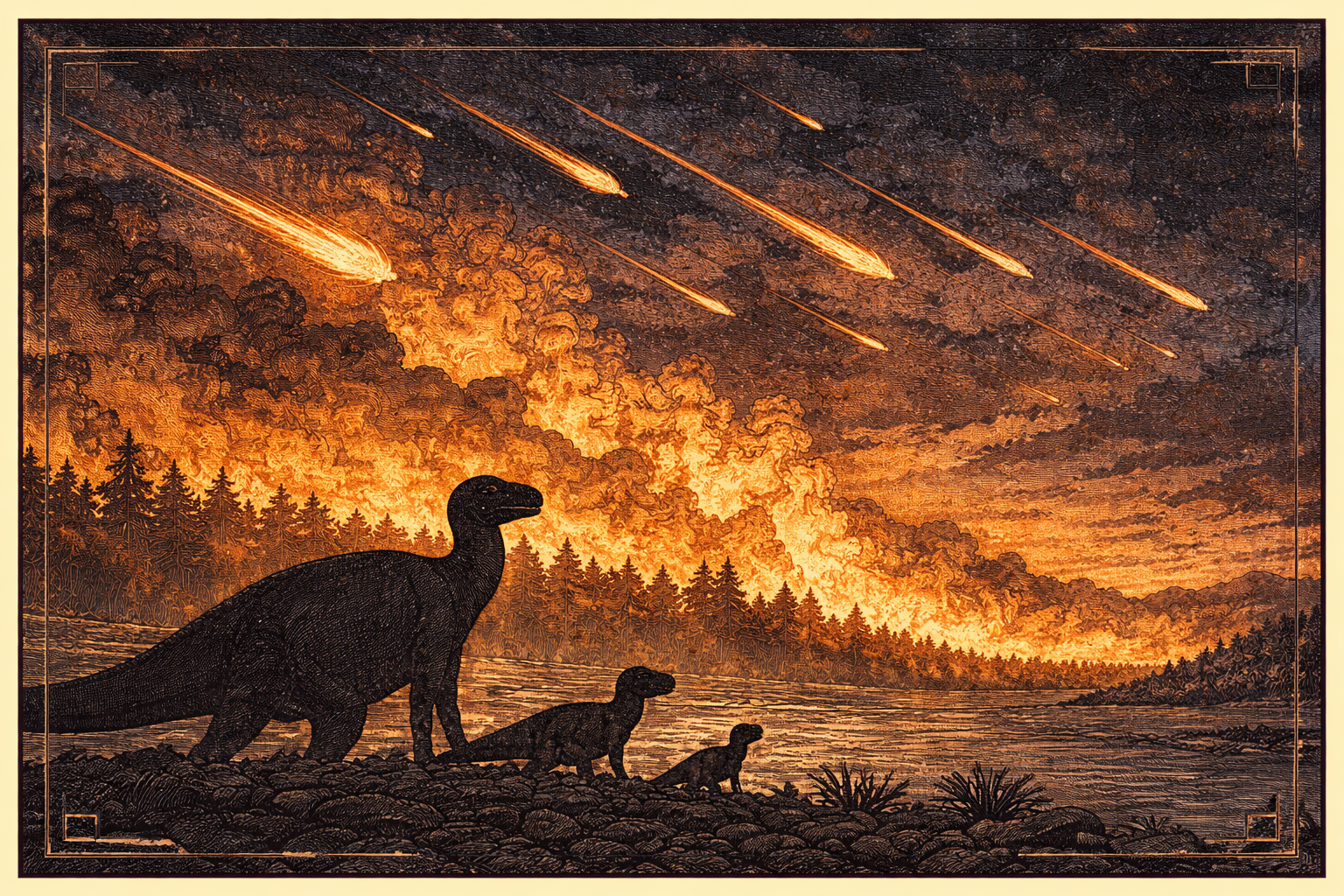
The rendering resolved into hell.
The sky was orange, choked with debris. Forests burned on every horizon. The air must have been unbreathable—ash and sulfur and the chemical signatures of a planet in shock.
"Impact winter," Susan whispered. "Months after the strike. The debris cloud would have circled the globe."
The rendering showed bodies. A hadrosaur skeleton collapsed beside a choked water source. Smaller forms strewn across the hellscape.
"Can we go back further?" David asked. "Before the impact?"
"Starseed?" Jennifer's voice was sharp. "Respond."
His avatar stood motionless, facing something the others couldn't see. Vital signs spiking—heart rate 158, the unrecognized neural pattern growing stronger.
"There's something here," he said. His voice was wrong—layered, as if multiple versions spoke slightly out of sync. "Not in the aftermath. Deeper. At the boundary itself."
"Pull back," Jennifer said. "Execute withdrawal protocol."
"I can't. It's—" He stopped. His avatar's head turned toward a point in the rendered sky. "It knows I'm here."
Amara's displays lit up with warnings. "He's not navigating anymore. Something else is using the channel. Information is flowing into him."
"Shut it down."
"The field won't collapse. It's like the connection is being held open from the other end."
"David, help her. Cut power if you have to."
David was staring at his displays, face pale. "There's a signal. Not navigation patterns—something structured. Coming from the boundary layer itself."
"I don't care. Shut it down!"
"Jennifer." Starseed's voice, suddenly clear. "I understand now."
She turned. His avatar was motionless, but his body in the navigation chair was trembling—fine tremors, hands gripping the armrests white-knuckled.
"Understand what?"
"The visions. Years of geometry and strange animals. I thought I was receiving fragments. But I wasn't." His voice caught. "I was being prepared. Calibrated. Made ready for this moment."
"Ready for what?"
"To carry the message back."
His avatar turned to face her. His voice carried wonder and terror in equal measure.
"They're not gone," he said. "They're still—"
The seizure hit like lightning.
Starseed's body went rigid, back arching, every muscle contracting. The helmet cracked against the headrest. A sound came from his throat—not words, not a scream, something that didn't sound entirely human.
"Tonic phase," Jennifer said, training taking over. "Get the helmet off. Amara, kill the power. Susan, call 911—grand mal seizure, possible cardiac involvement."
She was already moving, hands finding the helmet releases, pulling it away from his convulsing head. His eyes were rolled back, showing white. Foam at the corners of his mouth.
The seizure shifted—tonic to clonic, rigid contraction giving way to violent jerking. Jennifer positioned herself to protect his head.
"Airway clear. Breathing—" His chest wasn't moving. "Breathing absent. Starting rescue breathing."
"The field won't collapse." Amara's voice was panicked. "Something is holding it open."
"Then physically disconnect. Pull cables."
David moved finally, yanking connections. Sparks flew. Displays went dark. The quantum array's hum died.
Starseed's seizure stopped.
Silence. Then Susan on the phone with 911. Amara checking system status. Jennifer's fingers at Starseed's throat.
"Arrhythmia. Irregular heartbeat. Breathing shallow but present." She tilted his head back. "Starseed? Can you hear me?"
No response. The person who had been behind those eyes was somewhere else.
"ETA on paramedics?"
"Eight minutes."
"Too long. David—defibrillator?"
"Down the hall."
"Get it. Now."
The paramedics arrived in seven minutes.
They took over—IV access, cardiac monitoring, oxygen. Jennifer gave them the history: seizure disorder negative, cardiac history negative, exposed to experimental equipment involving electromagnetic fields.
She didn't mention the boundary. She said "experimental quantum computing interface" and watched them nod.
Starseed was loaded onto a gurney, still unconscious. His face was slack, younger-looking.
"I'm going with him," Jennifer said.
No one argued.
The four of them stood in the wreckage.
Cables dangling. Displays dark or showing errors. The smell of burned electronics.
David sat in Starseed's vacated chair. "I did this. I built the machine that did this to him."
"We all did," Susan said. "Every one of us wanted to see."
Amara was pulling up logs. "The session data is intact. There's audio from the last seconds."
She played it.
"They're not gone. They're still—"
Static. The sounds of seizure. Amara stopped the playback.
"Still what?" Susan asked.
"The sentence doesn't complete."
Margaret spoke quietly. "When Starseed reached the boundary, my instruments detected a resonance cascade. The signature harmonized with the older layers beneath it—all of them. Like tuning forks responding to the same note."
"You told us about the older signatures at Tierra del Fuego," David said. "But this is different?"
"The older deposits aren't just separate recordings. They're connected. Part of the same system. When Starseed touched the boundary—the moment of arrival—he touched something deeper." She paused. "The resonance suggests the layers are linked. Aware of each other."
"Aware?" Susan's voice was sharp. "The material isn't aware. It's chemistry."
"I know what we said. But Starseed said something was there. Something that knew he was there. And the structured signal flowing through his neural patterns—that's not a record. That's a response."
Silence.
"Maybe it was passive," Margaret said. "Before anyone learned to read it. Before anyone opened a channel deep enough to reach the insertion event." Her voice was quiet. "Maybe we woke something up."
David walked to the window overlooking the parking lot where the ambulance had been.
"They're not gone," he said. "That's what he said. Still here. Still in the record. Still waiting for someone to read them, and when someone finally did—"
"We don't know that." Susan's voice caught. "Until he wakes up and tells us—if he wakes up—we're guessing."
David's phone buzzed. Jennifer.
Stable. Unconscious. They don't know when he'll wake. His brain activity is abnormal—organized patterns they've never seen. Like he's still navigating. Like he's still somewhere else.
He read it twice. Then typed:
We'll find out what happened. We'll bring him home.
He didn't know if that was a promise he could keep.
The record had been waiting longer than they could imagine. And now, for the first time, something had read it—and it had noticed.
They're not gone. They're still…
The sentence hung incomplete.