Chapter
TIERRA DEL FUEGO
1,296 words · 7 min read
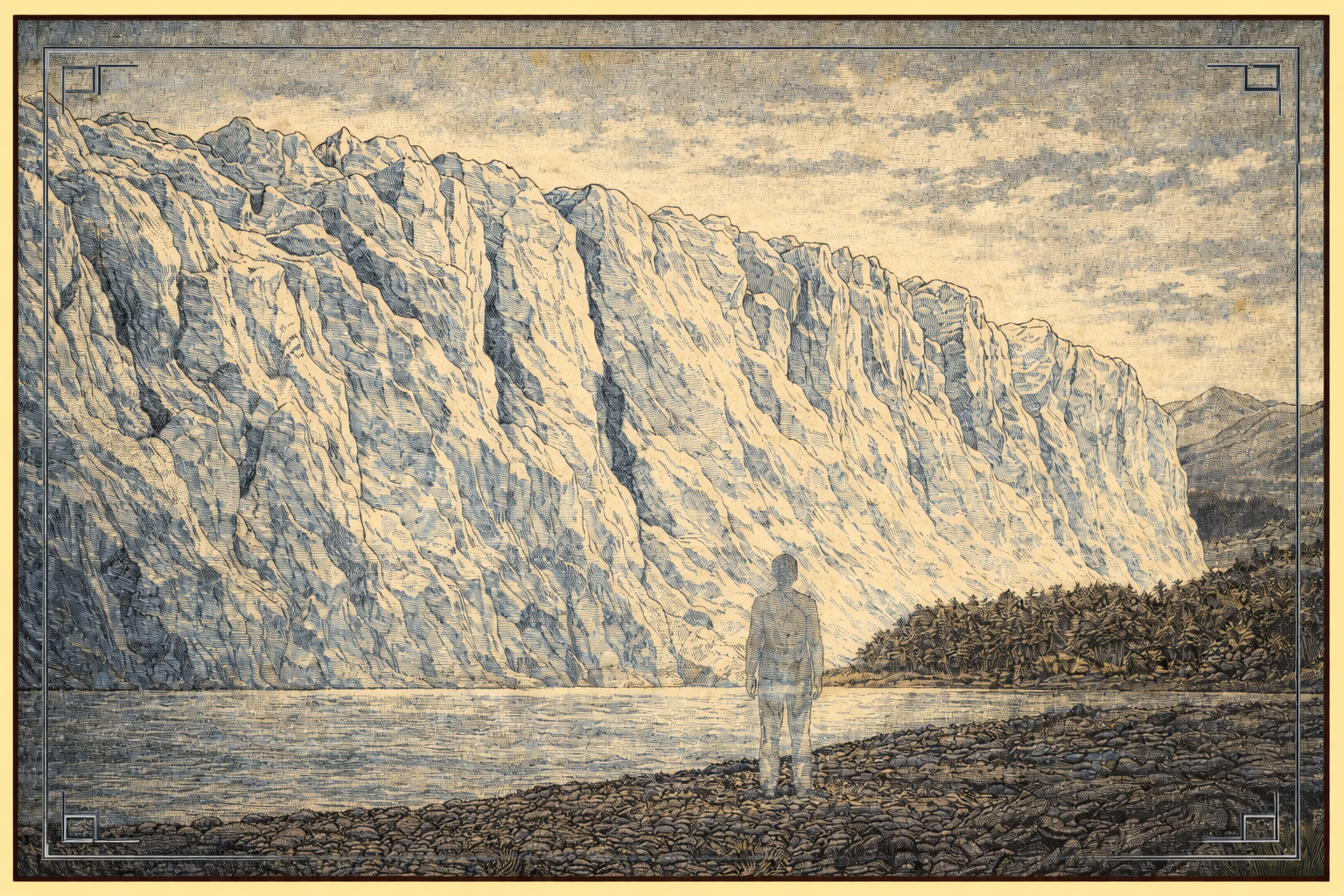
The glacier filled the rendered sky.
Blue-white ice rising from the channel in a face so vast the VR system struggled to resolve its edges. Crevasses dark as wounds. Susan stood on the shore and felt small in a way the Galápagos hadn't managed. The finches had been intimate—speciation at human scale. This was time made visible, compressed into ice.
"Twelve thousand years before present," Margaret said. "Late Pleistocene. Already retreat—the glacial maximum was earlier. But the ice sheets still covered most of Patagonia."
Across the channel, a mountainside showed its bones—layers tilted and folded, dark bands alternating with light.
"Darwin climbed a peak here and saw this," Susan said. "He wrote that the earth was a book. Every layer a chapter. He couldn't read it yet, but he knew it was written."
"Starseed, can you get us closer to the strata?" David asked. "I want to see the layer boundaries."
No response.
"Starseed?"
Jennifer's voice, sharp: "Give him a minute."
Susan turned toward the navigation point. Even through the crude mocap translation, something was wrong. Starseed's posture was rigid, his head tilted at an angle that suggested strain.
"The coherence is harder to hold here," Starseed said finally. His voice was thin. "The information density is different. Not more, exactly. Older. It feels older."
"The temporal depth is the same as Galápagos," Amara said. "Twelve thousand years."
"I know what the numbers say. I'm telling you what it feels like."
Margaret was watching her instruments. Susan saw her expression shift—something registering that she didn't share.
Margaret walked the tree line alone.
The others were clustered around Starseed, troubleshooting navigation. She could hear their voices—technical discussion, Jennifer's quieter tones keeping Starseed grounded. They were solving a problem.
She was looking at her instruments.
The crystallographic signatures were wrong. Not error—something she wasn't ready to name. The layer they'd calibrated to was present, dominant. But underneath it, faint but unmistakable, were older signatures.
She'd noticed them at Punta Alta. Dismissed them as noise. Noticed them again at Galápagos. Started tracking systematically. Now, at Tierra del Fuego, they were stronger. As if the glacial conditions—the cold, the pressure—had preserved something the warmer sites hadn't.
The older signatures didn't match any extinction boundary she'd documented. They were different. Earlier. And layered, one beneath another, like the strata across the channel.
How deep did it go?
"Margaret?" Susan's voice, closer than expected. "You keep looking at your instruments instead of the glacier. What are you seeing?"
Margaret hesitated. Years of keeping secrets.
"Anomalies," she said finally. "Older signatures beneath the main layer. I noticed them at Punta Alta, tracked them at Galápagos. They're stronger here."
"How much older?"
"I don't know. These are different. Earlier. The quantum signature has a different character."
Susan was quiet. Then: "You haven't told the others."
"I'm telling you."
"Why me?"
Margaret looked at the glacier, not at Susan. "Because you understand what it means to build a career on a framework that might be wrong. Your buckwheat work—decades of study, and then you saw geometry that shouldn't exist. You didn't panic. You followed the evidence."
"I'm still following it."
"So am I." Margaret finally met her eyes. "What we've been navigating is extraordinary. But if I'm right about the older signatures, it's just the top layer. Just the most recent chapter of something that goes back—I don't know how far."
"You're saying David's debris field model is confirmed."
"I'm saying we've been reading chapter sixty-six of a book that might have hundreds of chapters."
Susan absorbed this. "Why haven't you told David?"
"Because right now he and Amara are trying to hold navigation together, and Starseed is struggling, and Jennifer is worried about damage. Adding 'the record is older than we thought' helps no one."
"And after we're done here?"
"After we're done, I'll tell them. Once I have enough data." Margaret paused. "Or once we try to go deeper and the older signatures become impossible to ignore."
Susan looked toward the others. "You think we're going to try. The boundary itself."
"I think David has been building toward this since he was twenty-three. I think you want to see a dinosaur."
"I want to see the largest selection event in deep time. Everything after—including us—exists because of what survived."
"So yes. We're going to try."
"And you're worried."
Margaret looked at her instruments again. The older signatures pulsing faintly. "I'm a geologist. I study what's buried under what. Usually it's rock. But sometimes you dig down and find something that changes the whole picture."
The glacier calved.
A chunk the size of a house breaking from the face, falling into gray water. The wave rolled through their avatars without resistance.
"Did you see that?" Starseed's voice was strange—dreamy, distant. "When the ice fell. There was something in the recording. A different layer bleeding through."
"What do you mean?" Jennifer, sharp.
"I don't know. A flash. It's like—when the glacier calved, I saw time from the inside. Looking down into it instead of across." His avatar turned toward the exposed strata. "And it goes down a long way."
"Your neural patterns spiked," Amara said. "Significant excursion. Are you experiencing visual phenomena?"
"Not visual. Pressure. The way deep water feels. Except it's time instead of water."
Jennifer's hand tightened on his arm. "We should stop."
"Not yet." David's voice was intent. "Starseed, can you describe—"
"He said he's feeling pressure," Jennifer cut in. "That's not data. That's a warning."
"Everything he experiences is data."
"If we push too hard, there won't be anything left to document."
Susan watched the exchange. This was new—Jennifer and David pulling in opposite directions. The triumph was curdling into something else.
"I can hold it," Starseed said. "A little longer."
Margaret spoke carefully. "I've been tracking crystallographic anomalies since Punta Alta. Signatures beneath the main layer. Older material, different quantum characteristics. The glacial conditions here preserved them better."
Silence. Then David: "How much older?"
"I don't know. But the layering is consistent with your debris field model. Multiple deposits over time, each recording whatever existed then."
"So when Starseed feels pressure from below—"
"He might be sensing older recordings. Hundreds of millions of years of documentation beneath what we've been navigating."
"Can we access them?"
"David." Jennifer's voice was warning. "Not now."
"I'm asking if it's possible."
"The interface is calibrated for what we've been measuring," Amara said. "We'd need to recalibrate for older frequencies. If we knew what those were."
Starseed's avatar turned toward the glacier. "I can feel it. There's a floor beneath the floor. And beneath that, another floor. It goes down further than I can reach." He paused. "But I want to reach it."
"Not today," Jennifer said.
"No. Not today." His voice was clearer. "But the next step is obvious. We go to the beginning. The boundary. The moment everything changed."
The glacier groaned. Ice shifting, ancient air escaping.
"It's dangerous," Jennifer said. "We don't know what happens when we navigate that deep."
"I've been learning. Adapting."
"Each session accumulates damage. You can't feel it, but I see it in your vitals."
"Then we go carefully. Build better protocols." Starseed looked at David. "You've been waiting your whole life to ask this question. Margaret's been waiting decades. How much longer?"
David was quiet. Then: "Tomorrow. We rest tonight. Review the data. Build safety protocols. And tomorrow, we try."
Jennifer's silence was louder than objection.
Margaret watched her instruments, the older signatures pulsing beneath, and wondered what they would find when they finally looked deep enough.
The earth was a book. They were about to turn to the first page.