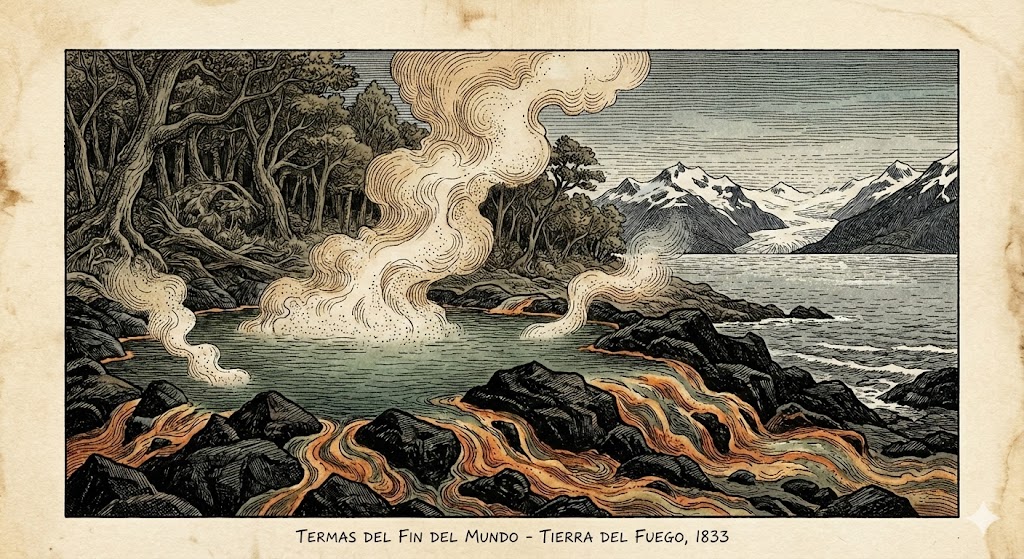
Tierra del Fuego, January 1833
The springs emerged from black rock at the edge of the forest, steam rising into air so cold it hurt to breathe.
Darwin crouched at the margin where hot met cold, notebook open, pencil moving in the cramped hand that would fill thousands of pages before the voyage ended. Temperature gradients. Mineral deposits. The strange orange staining where water touched stone. All of it recorded, fitted into the growing catalogue of observations that would eventually—though he did not yet know it—reshape how humanity understood itself.
But something here resisted cataloguing.
He had visited thermal springs before. The science was straightforward: volcanic heat, groundwater, the slow chemistry of mineral dissolution. Yet these springs felt different. Not warmer or more mineral-rich—different in some quality he could not name. When he held his hand in the water, he experienced a sensation beyond temperature. A pressure that was not pressure. An attention that could not be attention, because rocks did not attend.
He withdrew his hand and examined it. Unchanged. No mark, no residue beyond the expected mineral film. He made a note: Unusual sensation in thermal water. Subjective. Likely fatigue.
But he did not believe the explanation even as he wrote it.
The Fuegians avoided these springs.
Darwin had learned to pay attention to such avoidances. The natives understood their landscape with an intimacy no European …