Chapter
THE COLLECTION
978 words · 5 min read
The Natural History Museum was quieter than Amara remembered.
She'd come here as a child—school trips from Lewisham, her mother insisting on "educational outings" that would justify the bus fare. The dinosaur hall had terrified and fascinated her in equal measure. She'd stood beneath the Diplodocus skeleton and felt the weight of deep time pressing down, millions of years compressed into bone and stone.
Now she was back with equipment that might read what those bones had witnessed.
Margaret met her at the staff entrance on Exhibition Road, away from the tourist crowds. She was taller than Amara expected from video calls—a rangy woman with short gray hair and the weathered face of someone who'd spent decades in the field. Her handshake was firm, her eyes assessing.
"Dr. Okonkwo. David's spoken highly of you."
"Amara, please." She hoisted the equipment case. "Where's the collection?"
Margaret's mouth quirked. "Straight to business. Good. Follow me."
They descended into the museum's working spaces—corridors tourists never saw, smelling of preservation chemicals and the dry metallic scent of mineral storage. Margaret moved through the maze with long familiarity, nodding to colleagues who glanced curiously at Amara's case.
"The boundary samples are in Mineralogy. I've been storing them separately—easier to access without raising questions."
"Questions?"
"About why a senior research fellow keeps running private analyses on extinction boundary material." She glanced back. "There are limits to how much eccentricity the museum will tolerate. I've been walking that line for a long time."
They reached a door marked RESTRICTED ACCESS. Margaret keyed in a code.
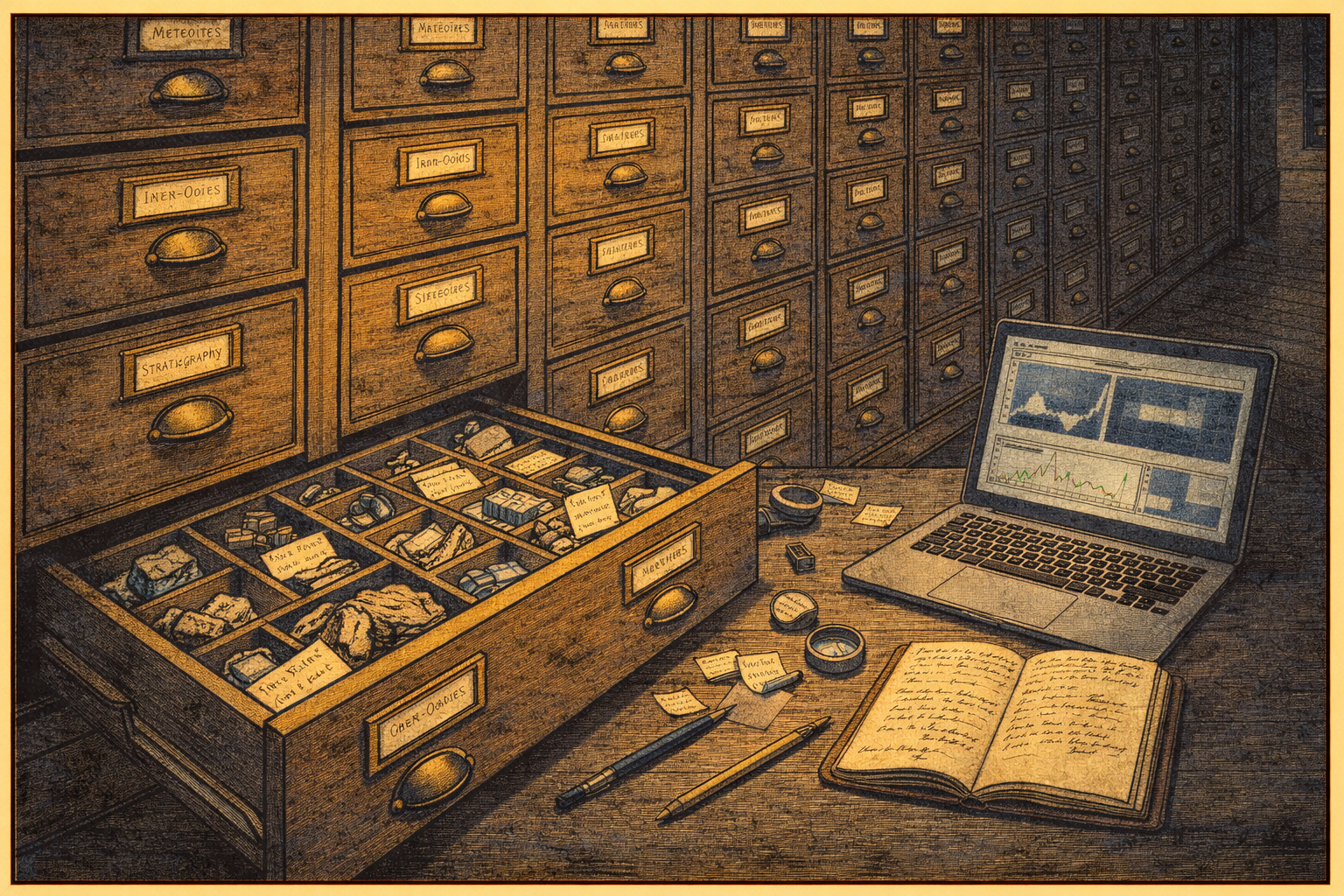
The room beyond was small, climate-controlled, lined with sealed cabinets. Each labeled in Margaret's careful handwriting: K-PG BOUNDARY. P-TR BOUNDARY. LATE DEVONIAN. END-ORDOVICIAN. SCOTTISH SITES.
And in the corner, a separate cabinet: BEAGLE COLLECTION - AUTHORIZED ACCESS ONLY.
"Twenty-seven years," Margaret said quietly. "Building this collection. Running analyses in off-hours. Documenting findings I couldn't publish."
Amara set the case on the workbench and began her setup sequence. Aerogel matrix, coupling mount, detection software initializing on her laptop. The familiar ritual of calibration steadied her.
"The adaptive optics will take a moment to find coupling," she said. "Natural samples don't have clean interfaces."
They started with K-Pg Montana—the boundary that killed the dinosaurs.
The software beeped. Coupling established. Amara watched the readout populate.
Ordering. Clear and unmistakable. The same periodic variations she'd found in Bear Valley, the same architecture that shouldn't exist in natural deposits. She heard Margaret's sharp intake of breath.
"That's it," Margaret said. "That's exactly what I've been measuring—but your detector shows the fine structure. The periodicity within the periodicity."
Amara ran the analysis twice more. Stable results. She logged the data and reached for the next drawer.
The middle sequence followed in a blur of confirmation. P-Tr Siberia, 252 million years old—same signature. Late Devonian Morocco, 372 million years—identical. When the End-Ordovician sample from Scotland showed the same ordering, Amara sat back from the bench.
Four extinction boundaries spanning 379 million years. Asteroid impacts, volcanic upheavals, glaciation—events with nothing in common except this.
"It's not local," she said. "It's not California geology. It's global."
"Longer than global." Margaret's hands were trembling slightly. "The Ordovician is just the oldest I have. If the ordering holds further back…"
"Then it's been here since before complex life."
They sat in silence for a moment, surrounded by cabinets full of deep time.
"There's one more," Margaret said. She crossed to the corner cabinet and entered another code. "The Beagle samples. Darwin's Punta Alta material."
She withdrew a small container, handling it with care that went beyond conservation protocol. Inside, cushioned in acid-free tissue, lay fragments of dark stone no larger than thumbnails.
"He was twenty-four," Margaret said. "Standing at Punta Alta, finding megatherium bones, beginning to understand that species could vanish. He pocketed these as geological curiosities. Carried them around the world. Stored them in his study while he wrote the notebooks that became The Origin of Species."
Amara selected the largest fragment and placed it in the coupling mount.
The adaptive optics took longer this time—the sample was small, degraded by nearly two centuries of storage. But the signal locked.
Ordering. Identical to the others.
Darwin had carried the same material home. Had worked in a room with evidence of something he couldn't have imagined, writing about descent with modification while his specimen drawer held information about processes at scales no one would comprehend for another two centuries.
"I need to call David," Amara said.
The call was brief. Five boundaries positive. Darwin confirmed. Global distribution across 379 million years minimum.
David's face on the screen showed the particular stillness of someone absorbing information that changed everything. "Stay as long as you need," he said. "Document everything. And Margaret—call Alasdair. See what the Rhynie site has found."
After they ended the call, the two women sat in Margaret's cramped office, surrounded by decades of research that had finally found its instrument.
"I should visit my parents," Amara said. "They're in Lewisham. I promised I'd come for dinner."
"Of course." Margaret stood, stretching joints that had been too long in one position. "Tomorrow we document properly. Then I'll call Alasdair."
Amara packed the detector carefully, cushioning it for the Tube journey across London. In a few hours she'd be sitting at her parents' table, eating rice and stew, listening to her father complain about the council and her mother ask about her work.
How could she explain what she'd spent the day measuring? How could she tell them that the comfortable world they knew might be sitting atop something vast and strange that had been recording since before there were eyes to see it?
She couldn't. Not yet.
But she'd carry the knowledge with her, the way Darwin had carried those Punta Alta fragments without understanding what he held.