Interlude
Tierra del Fuego — Darwin Timestream
1,162 words · 6 min read
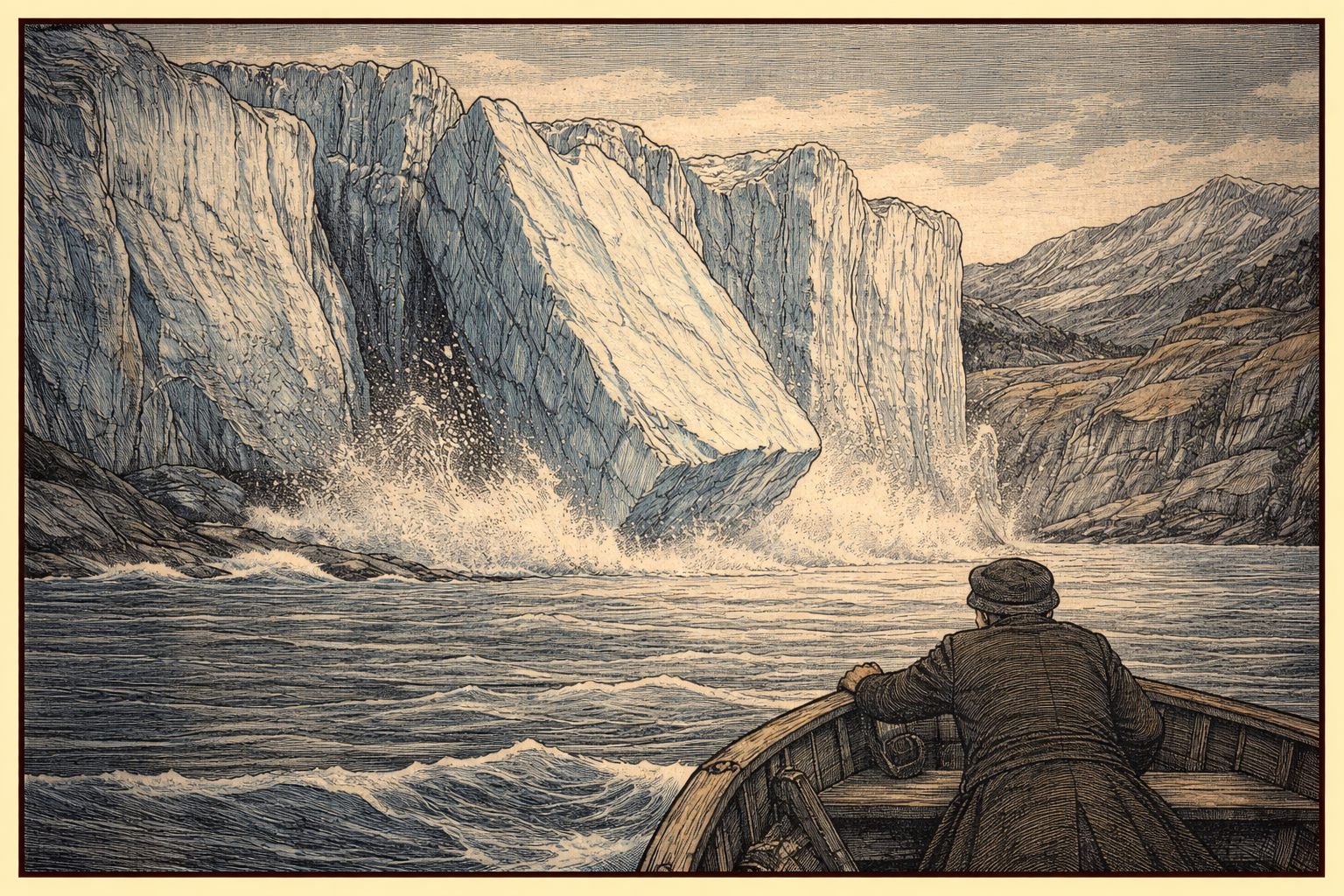
The glacier calved while he watched.
A slab of ice the size of a cathedral broke from the face and fell, slowly at first, then accelerating into the gray water with a sound like cannon fire. The wave rolled outward, rocking the boats anchored in the bay. Charles gripped the gunwale and watched the new iceberg settle into its floating life, ancient air escaping from crevasses in streams of bubbles.
How old was that ice? Lyell's Principles sat in his cabin, pages soft from reading. The earth was old—he understood that now, viscerally, in ways Cambridge had never taught. The glacier had been forming when Stonehenge was built, when Rome was a village, when the ancestors of everyone on this ship were painting animals on cave walls.
And it was still forming. Still flowing. Still calving cathedrals into water so cold it would kill a man in minutes.
Covington had the collecting gear ready when they went ashore.
The beach was glacial debris—boulders dropped by retreating ice, gravel sorted by waves, the wrack line thick with kelp and shell. Charles moved through it systematically, his eye trained now for what mattered: sediment, fossil fragments, anything that spoke of the land's history.
He found a shell bed exposed in a low cliff, ancient mollusks pressed into stone. Marine creatures, clearly, but the cliff stood forty feet above present sea level. Either the sea had fallen or the land had risen. Lyell argued for gradual uplift—earthquakes accumulating over millennia, inches becoming feet becoming the cordillera itself.
Charles had felt an earthquake in Chile. Would feel a greater one in a few years, would watch the coastline rise measurably in a single afternoon. The land moved. The sea moved. Everything moved, given enough time.
The Yahgan watched them from the treeline.
Three figures, nearly naked despite the cold rain—only scraps of seal skin across their shoulders. They made no move to approach, no move to flee. Just watched, with the particular attention of people who had seen ships before and learned that watching was safer than engaging.
Charles thought of Jemmy Button, still aboard the Beagle, waiting to be returned to these shores. Three years in England—educated, dressed in fine clothes, learning to use a knife and fork, to make polite conversation, to be astonished by the size of London. In a few weeks FitzRoy would land him at Woollya with the other Fuegians they'd brought back.
What would Jemmy think, seeing his family again? Would they recognize the man he'd become? Would he recognize the life he'd left?
The Yahgan were human—clearly, obviously, undeniably human. They made tools, built shelters, raised children, buried their dead. But they seemed to exist at some earlier stage of… what? Development? Civilization? The words available to him were inadequate and faintly shameful.
The woman held a child he hadn't noticed at first—a small bundle pressed against her chest, sheltered from the rain by her body. Motherhood, at least, needed no translation.
The next morning he climbed.
A peak behind the cove offered views across the channels. Covington stayed with the boats; this was not a collecting expedition. This was something else—a need to see the shape of the land from above.
The climb was difficult. Loose scree, then dense vegetation, then bare rock polished by ice long since retreated. He arrived at the summit breathing hard, his hands scraped, his boots soaked.
The view was not what he'd expected. He'd expected grandeur, and there was grandeur—the sweep of channels, the white bulk of glaciers, the distant peaks fading into cloud. But what held him was something else.
The mountainside across the channel showed its structure nakedly, strata tilted by forces he couldn't imagine, folded and faulted and exposed. Dark bands alternated with light. Some held fossils he could see even from this distance—pale shapes embedded in darker rock.
The earth was a book. He'd known this intellectually, had read Lyell's arguments for reading geological sequence as historical record. But standing here, looking at a mountainside that displayed millions of years of accumulation in a single view, he felt it differently.
Every stratum was a chapter. Every fossil a sentence. The whole thing was written by processes that didn't require authors—that simply accumulated and preserved and displayed for anyone patient enough to read.
The thought was vertiginous. He sat down on the cold rock, suddenly aware of his own smallness.
Somewhere in that accumulation, his ancestors had emerged. The Yahgan's ancestors. Every ancestor of every creature that had ever lived. Back and back and back until the strata themselves began.
He didn't have the theory yet. Wouldn't have it for decades—the long gestation of an idea too large to be born quickly. But sitting on a peak in Tierra del Fuego, looking at a mountainside that was also a library, he felt the shape of something.
He descended slowly, stopping often to collect, to sketch, to simply look. Near the bottom, where a stream cut through the scree, steam rose into the cold air. A thermal spring, here among the glaciers.
He didn't approach closely—the descent had taken longer than expected, and Covington would be waiting—but he noted the location in his book. The rocks surrounding it showed mineral staining, and something else caught his eye: a dark layer in the sediment at the water's edge. Dense, metallic, out of place.
He picked his way close enough to pocket a fragment.
The Yahgan, he had noticed, gave such places wide berth. He'd learned to pay attention to their avoidances. When the natives declined to camp near certain places or fell silent passing certain stones, there were usually reasons—encoded in generations of observation that predated written science.
He made a note to return before the Beagle sailed.
Back at the boats, Covington had lunch waiting.
"Strange place," Covington said finally.
Charles nodded. "It stays with you."
The place stayed because it showed the truth more nakedly than gentler landscapes. No forests to soften, no civilization to distract. Just rock and ice and water, the bare bones of a planet that had been doing this—building, eroding, accumulating—for longer than minds could hold.
The Beagle would remain in these waters for weeks yet, surveying the maze of channels. There would be time to return to the springs, to investigate properly. Time to watch Jemmy Button step back onto the shore where he'd been born, dressed in English clothes, carrying English manners, returning to a people who had survived these glaciers for ten thousand years without any of it.
Charles wondered which world would claim him. The one that had shaped his ancestors, or the one that had reshaped him.
Perhaps that was the question the landscape kept asking. Not just of Jemmy. Of everyone.
The earth remembered. He was learning what that meant.