Chapter
PUNTA ALTA
1,280 words · 7 min read
David had brought the paper.
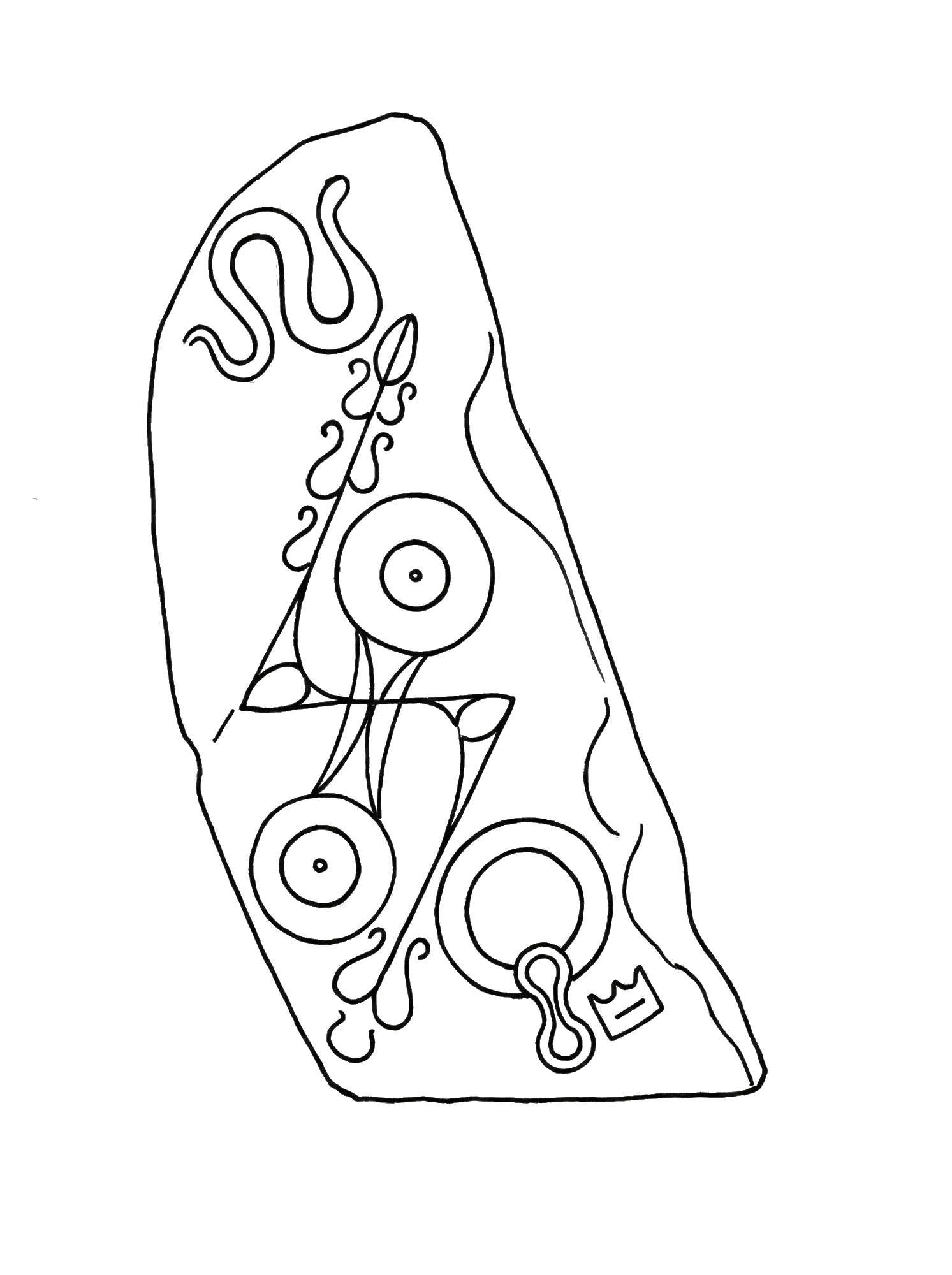
It sat on the console now, dog-eared and annotated in two hands—his and Margaret's, from years of correspondence under their SCA names. Topological Analysis of Pictish Symbol Stone Interlacement. The manuscript they'd never published because they couldn't explain what they'd found.
The team had read it overnight. Susan had questions. Amara had questions. But those could wait. What mattered now was whether the geometric relationships they'd documented actually worked as navigation protocols.
"The knotwork patterns correlate with access depth," Margaret was explaining, pages spread across her workstation. "Topological invariants as waypoint markers. Fractal scaling as zoom controls. If we're right, these give Starseed a method for specifying destinations."
Amara had modified the rendering engine overnight, building visual overlays for the complex patterns. When Starseed needed to generate a particular form, he would see it as a template to match.
"Ready to test it?" David asked.
Starseed sat in the navigation chair, Jennifer beside him. He looked hollowed but steady—he'd actually slept, Jennifer reported, for the first time in days without geometric pressure behind his eyes.
"Let's see if your paper is worth six years in a drawer," he said.
The first hour was calibration.
Starseed practiced the knotwork patterns while Amara's overlay guided him. His neural activity shifted. The detector responded. Coherence deepened in ways they'd never measured before.
"That's a Class III interlacement," David said, watching the readings. "We've never seen that topology in the detector."
"It feels like opening a door," Starseed said. "The surface patterns were corridors. These are rooms."
On the team's displays, new regions resolved into visibility. Not broad taxonomic categories but specific branches. Particular lineages.
"These correlate with geological site data," Margaret said, checking coordinates. "The record isn't just temporal—it's spatial. Every entry has a location."
"Can we navigate to a specific place?" Susan asked. "A known fossil site?"
Starseed's voice was strained but steady. "Show me where."
They chose Punta Alta.
David suggested it—the site where Darwin had first felt the puzzle taking shape, where he'd pocketed the dark fragment that still sat in the Natural History Museum's collection. The coordinates were in Margaret's database.
"Late Pleistocene," Margaret said. "Twelve thousand years before present. The megafauna would still be alive."
Susan checked her cladogram overlay. "If the zoomorphic markers work the way we think—the swimming elephant should correlate with South American megafauna from that period."
"Should," Starseed said. "Let's find out."
He took a breath. Jennifer breathed with him.
"I can feel something at those coordinates," he said. "Pressure. Density. There's a lot of record concentrated there."
"Geothermal system," David said. "Argentina has hot springs. The crystalline material would concentrate near thermal sources."
"Going in," Starseed said.
The Navigation Room dissolved.
Grassland stretched to every horizon.
The rendering couldn't capture smell, but it captured everything else. Low scrub under a sun that sat differently in the sky. Hills in the distance. A watercourse threading through the basin.
And sounds. Birdsong, but wrong—different species. Insect drone. Something moving through brush.
"Full immersion," Amara reported. "Starseed's patterns are stable."
Jennifer stood beside Starseed's avatar in the rendered space. "I can see it," she breathed. "I can actually see it."
"We're observers," David reminded them. "The rendering is translated from the record. We can move through the space but can't interact with it."
Susan had already started walking. "The vegetation patterns are consistent with late Pleistocene climate reconstructions. Drier than today. More open woodland."
"There's a concentration of signal this way," Starseed said. His voice was strange—half in the lab, half elsewhere. "Something significant was recorded here."
They moved through grass that didn't bend beneath their feet, past shrubs that cast no shadows on their rendered forms.
The clearing opened before them.
And in the clearing, something enormous was moving.
Susan had seen reconstructions. She'd studied skeletal diagrams, read papers on locomotion and feeding behavior. She thought she understood what a giant ground sloth was.
She was wrong.
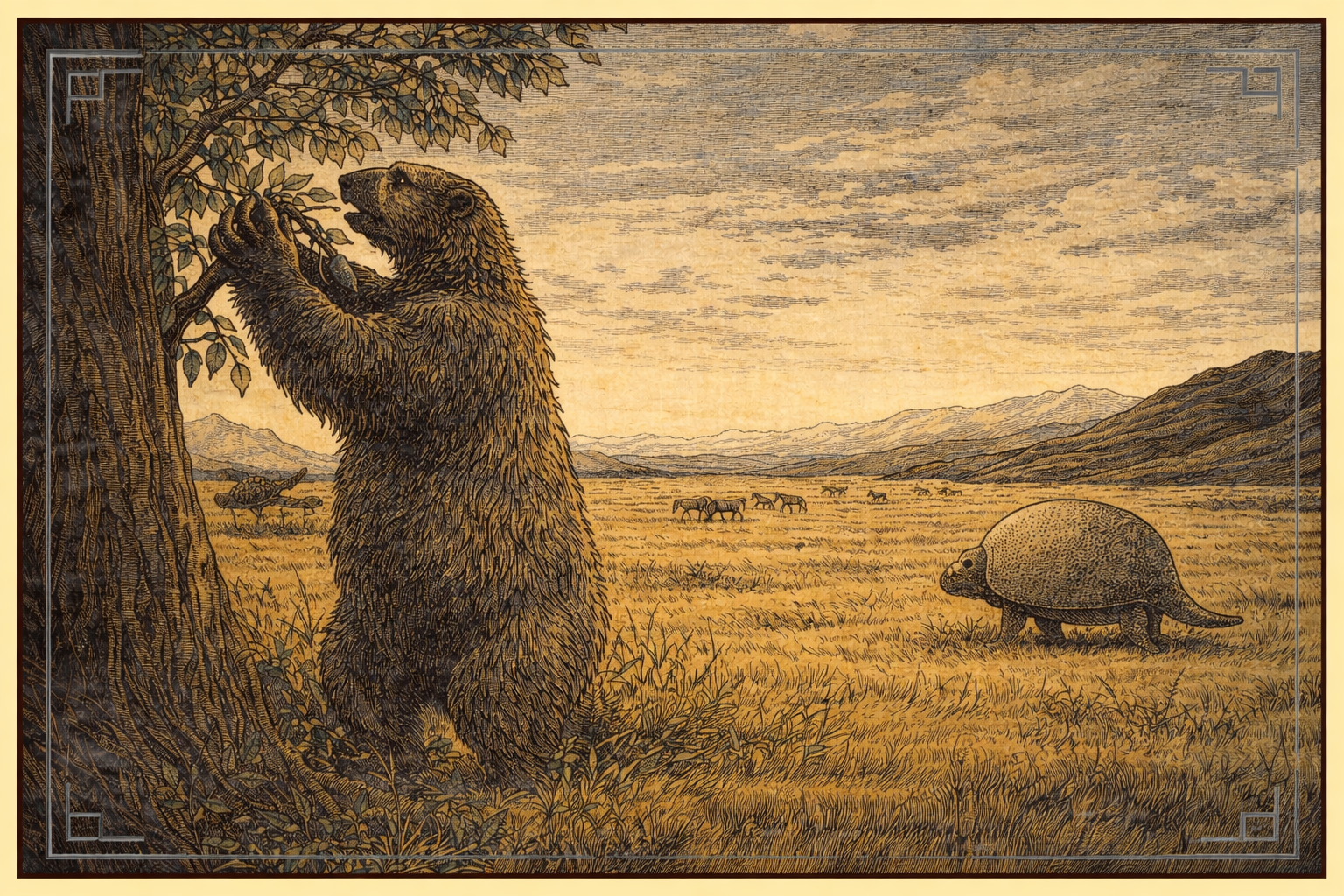
The Megatherium stood twelve feet tall at the shoulder, its body massed like a small hill, covered in coarse reddish-brown fur. Its arms ended in claws that curved like scythes—not weapons but tools for pulling down branches, for stripping bark.
It was eating. Its head, unexpectedly delicate for such a massive body, pulled at leaves on a thorny shrub. A sound—low, resonant, somewhere between a groan and a hum—vibrated through the recording.
"Oh," Jennifer said. Just that.
"The zoomorph wasn't stylized," Margaret murmured. "It was observed. Something recorded this creature in a form that persisted for twelve thousand years."
"High-density crystallographic signature at this location," David said, checking his display. "Whatever process binds the material to biology, it concentrated here. This individual was documented in detail."
"Can we get closer?" Susan asked.
Starseed's avatar turned to her. "I can navigate us nearer. But the information density increases. It's like walking into pressure."
"Only if you can hold it," Jennifer said.
"I want to see it." His voice was quiet. "Six years of fragments. Symbols. Geometry. This is what they were pointing toward."
He moved forward. The team followed.
The Megatherium's head swung toward them—not seeing, responding to something outside the rendering's range. Its eyes were small and dark, set in that unexpectedly delicate face.
"It's aware of its environment," Susan said. "Look at the scanning behavior. These were intelligent animals. Not primate-intelligent, but adapted. Attentive."
"Darwin called them grotesque," Margaret said. "Inflated versions of living sloths. But this isn't grotesque. It's just different. A different solution to the problem of being alive."
The creature lowered its head and returned to eating. The grinding of its teeth. The rustle of falling leaves. An animal in its element, unaware that in twelve thousand years its kind would be gone.
Starseed sank to his knees.
Not from strain—his vitals were stable—but from weight. From something else.
"This is real," he said. "I spent six years thinking I was crazy. Or special. Or chosen. I made up stories about cosmic consciousness because I didn't have another way to understand what was happening to me."
His voice broke.
Jennifer knelt beside him. Her avatar's hand passed through his shoulder in the rendering, but her real hand was solid on his arm.
"You weren't crazy," she said. "You were perceiving something no one knew how to perceive. The stories were wrong, but you weren't. You held on long enough for us to catch up."
"It's not a message," Starseed said. "It's not trying to tell me anything. It's just—"
"A record," David said. "And you're learning to read it."
In the clearing, the Megatherium finished its meal and began to move. Other shapes were visible now—a Glyptodon armored like a living tank, something long-necked that might have been Macrauchenia.
An ecosystem. A world. Alive in the record.
Susan was crying. She didn't try to hide it. "This is what we've always wanted. Every paleontologist who's looked at bones and tried to imagine the living animal. We can see them. We can watch how they moved."
"And how they died," Margaret said quietly. "The record captures everything. We're going to see things we may not want to see."
The session ended gradually—Starseed's signal weakening, the rendering fragmenting, the grassland dissolving back into the Navigation Room. The Megatherium faded last.
They sat in silence as the displays powered down.
Starseed was leaning against Jennifer, exhausted but clear-eyed.
"I'm not a receiver anymore," he said quietly. "I'm not just getting signals. I'm going places."
Jennifer helped him to his feet.
"Same time tomorrow," he said. "We're just getting started."