Chapter
GALÁPAGOS
944 words · 5 min read
Amara had worked through the night.
The navigation data from Punta Alta had revealed something she'd almost missed: the archive's spatial encoding was standardized. Every record geotagged with coordinates that matched planetary geography. By morning, she had Earth Engine integration running—the quantum array's output feeding directly into Google's planetary mapping system.
Susan was studying the coherence overlay Amara had built. The Galápagos pulsed with signal density.
"Look at where the signal concentrates," Susan said slowly. "Not just thermal sources—island archipelagos, mountain ranges, coastlines. Places where evolution would have been most active."
"Darwin traced a path through these zones without knowing why," Margaret added. "Punta Alta. Galápagos. Tierra del Fuego. He followed the gradients."
"We're not retracing Darwin's voyage," Starseed said quietly. "We're both tracing the same thing."
The volcanic landscape materialized around them.
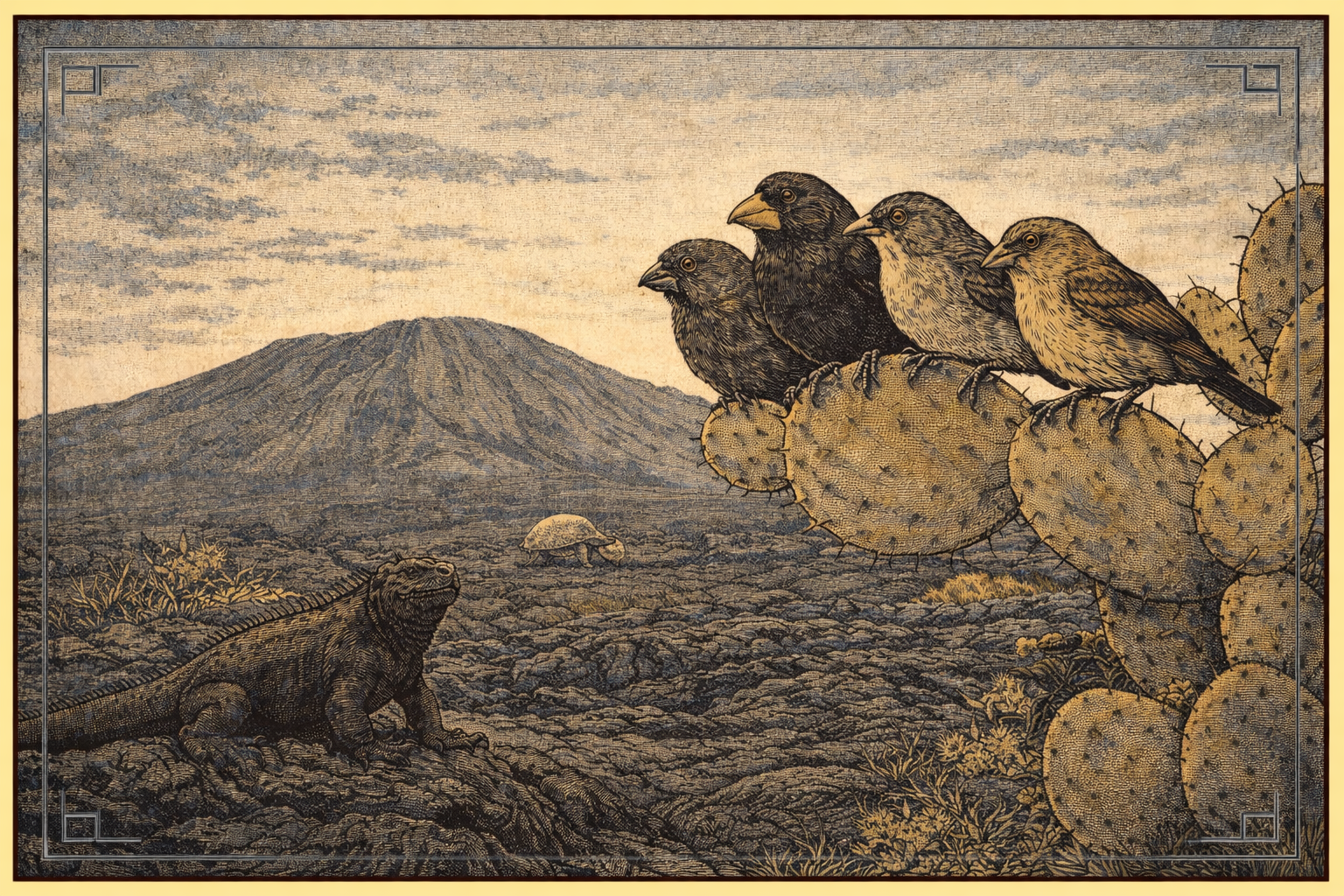
Black rock. Scrubby vegetation clinging to fissures. Sky so deep blue it hurt. Everything about the visual said furnace—an archipelago built from fire, still becoming itself.
"James Island," Margaret confirmed. "September 1835. The temporal signature is consistent with Darwin's visit."
"Is that coincidence?" Susan asked.
"Darwin collected samples here. Those samples sat in museum collections. Margaret tested them." Starseed's voice was strained. "The samples might have created a resonance. A connection between then and now."
Susan was already moving through the rendered terrain. "Show me a finch," she said. To the archive. To herself.
Starseed's neural patterns shifted. The rendering responded.
And suddenly they were surrounded by birds.
Not a flock—a population, distributed across the scrubland, each bird going about its business in the particular way its beak allowed.
Susan moved among them like a ghost.
"Ground finch," she said, pointing. "Large ground finch—look at that beak, built for cracking hard seeds. And there—" She spun. "Medium ground finch. Smaller beak, smaller seeds. Same ancestor, different niches."
The birds ignored her entirely. They couldn't see her, couldn't sense her passage.
"It's not just the beaks. Watch the feeding patterns. The large ground finch goes for the big seeds, ignores the small ones. The medium ground finch does the opposite. They've partitioned the resource."
"Character displacement," Margaret said. "Competition driving divergence."
"Darwin saw this. He collected specimens, noted the variation, but didn't understand what he was seeing. It took him twenty years." Susan's voice caught. "We're watching it in twenty minutes."
She moved to where a cactus finch was probing Opuntia stems. Its beak was longer, more curved. A few meters away, a woodpecker finch was using a twig to extract larvae from bark. Using a tool. Behavior preserved in crystalline record for two centuries.
"This is what I've wanted my whole career," Susan said. "Not reconstructing from fossils and cladistics—actually seeing evolution producing diversity."
"It's a record," David reminded her. "Not real time."
"The record is detailed enough that the distinction barely matters."
Starseed's voice came through strained: "The signal density here is intense. Multiple lineages converging. Multiple speciation events in overlapping layers. It's like trying to read ten books at once."
"Pull back if you need to," Jennifer said.
"Not yet. I want to understand why this place matters so much."
Susan had an answer. "Because evolution was working harder here than almost anywhere else on Earth. Geographic isolation. Empty niches. Strong selection pressures. The archive concentrated here because there was more to record."
"More information per unit of time," David said.
Margaret was monitoring her own display quietly. The anomalies she'd noticed at Punta Alta were present here too—faint echoes of older material beneath the dominant layer. She didn't mention it. She was building her case. Some patterns needed more data before they became conclusions.
Jennifer watched Starseed.
His heart rate was higher than yesterday. Breathing less steady. The tremor in his hands had returned—not visible in his avatar, but she could feel it under her fingertips.
"Time to come out," she said.
"Five more minutes."
"Your vitals say otherwise."
"Jennifer—"
"This isn't negotiable." Her voice was gentle but final. "We have tomorrow. We have all the tomorrows we need. But not if you burn out today."
Starseed's avatar turned to face her. His voice carried exhaustion deeper than physical tiredness.
"It's so much. The information density. I can feel it pressing against the edges of what I can hold."
"No one sees it all. You browse. You sample. You follow threads and let others wait."
"What if we miss something?"
"Then we come back. The archive has been here longer than we can imagine. It can wait a few more weeks."
Slowly, he began the disengagement sequence. The Galápagos faded. The finches dissolved.
He pulled off the helmet and sat with shaking hands.
"Two sessions in two days," Jennifer said. "Both deeper than anything before."
"I know." His eyes met hers. "Tierra del Fuego next. The glacial record. And after that—the boundary itself. Sixty-six million years ago."
"That's not tomorrow's problem."
"No. But it's coming." He looked around at the others—Susan lost in her notes, David and Amara at the quantum array, Margaret cataloging data. "We've proven it works. The question now is how deep we can go."
"And how deep is safe."
"That too."
Amara was running calculations. "Tierra del Fuego, Pleistocene—the tectonic correction is small. But for K-Pg…" She pulled up the paleogeographic model. The continents slid into unfamiliar positions. "The world won't look like our world anymore."
Margaret watched her own display, where the crystallographic anomalies were adding to the pattern she'd been tracking. Older signatures. Deeper layers. The boundary was coming—and underneath it, something else waited.
She didn't mention it. Not yet.